If plants had a voice, most wouldn’t grumble about fertilizer blends, soil pH, or even the amount of sunlight they get first.
Instead, they’d murmur something far simpler — and far more ignored:
“Please wipe my leaves.”
On balconies in Mumbai, terraces in Delhi, courtyards in Chennai, and backyards in Varanasi, plants silently battle a thin yet stubborn coating of dust, city smog, cooking grease, pollens, and tiny insect leftovers. What once were glossy, vibrant leaves turn dull, sticky, and worn out. And when leaves can’t “breathe” or catch light well, everything slows: growth falters, flowers weaken, susceptibility to pests rises — yet many gardeners scratch their heads asking, “Everything seems right… so why do my plants still look tired?”
Here’s the honest truth:
Dirty leaves make weak plants — no matter how rich your soil is or how often you feed them.
Leaves are not just decorative — they are the plant’s solar panels, the gateways through which energy and air move. When dust or grime blocks this process, the plant literally can’t work properly. In India’s often dusty, smoggy, or humid environments, this effect accelerates — especially in cities or during dry, dusty months.
In the paragraphs that follow, we’ll unpack:
- Why leaf cleaning isn’t a luxury — it’s essential.
- How invisible dust can quietly stunt your plant’s growth.
- Simple, gentle habits that bring back sparkle, strengthen plants, and boost resilience — without hurting delicate leaf surfaces.
Because once you learn to care for your plant’s breathing surface, everything else — from nutrient uptake to flowering — begins to thrive again.
🌱 Why Leaves Matter More Than We Think (And How Dirt Slowly Damages Them)
Leaves aren’t just there to make a plant look lush or green.
They are the working organs of the plant — quietly keeping everything alive.
Think of each leaf as a living power station. Every single day, it performs several jobs at once:
- Creates food by turning sunlight into energy
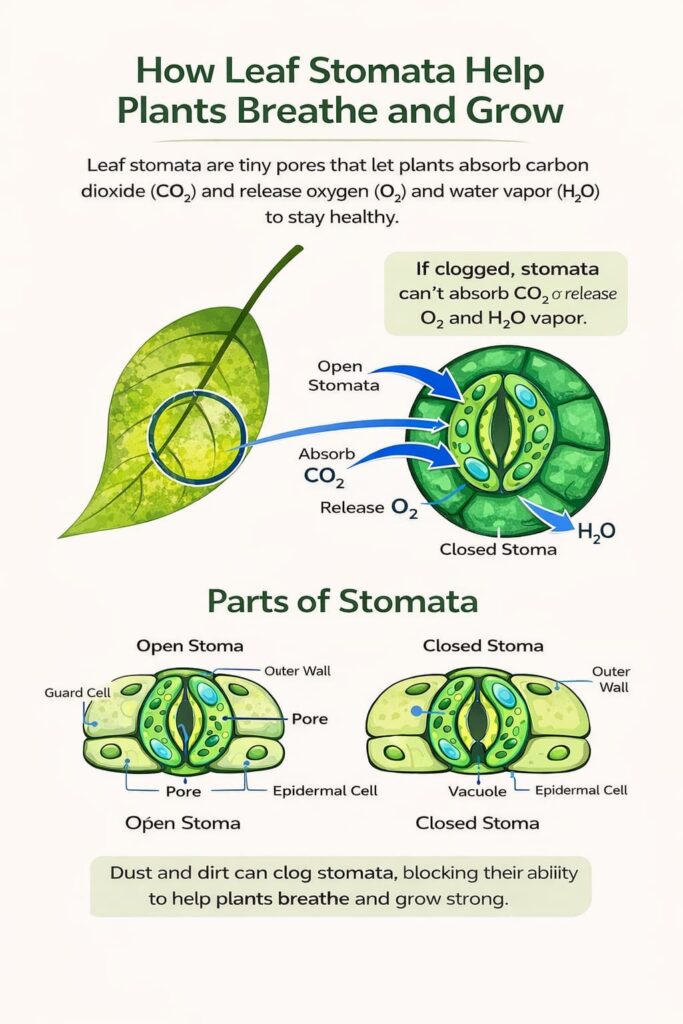
- Breathes through microscopic openings called stomata
- Regulates temperature, releasing excess heat
- Manages moisture, deciding how much water to retain or release
When leaves are clean, all of this happens smoothly and efficiently.
When they’re dirty, the system starts to fail — slowly, silently, and often unnoticed.
A layer of dust may look harmless, but it acts like a curtain pulled halfway across a window. Sunlight struggles to reach the leaf surface, stomata begin to clog, heat gets trapped, and the plant has to work harder just to survive. Over time, energy production drops, immunity weakens, and growth becomes hesitant. Even a faint grey coating can reduce photosynthesis far more than most gardeners expect.
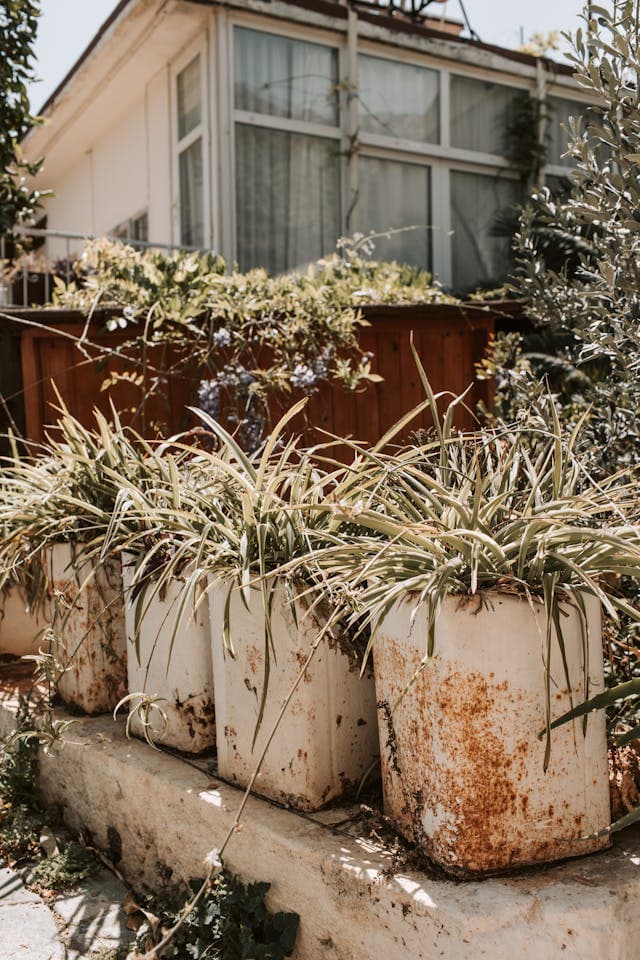
In Indian cities and towns, leaves face constant assault from the environment:
- Fine construction dust that settles daily
- Vehicle exhaust and airborne pollution
- Cement particles carried by dry winds
- Smoke residue from kitchens or nearby burning
- Mineral stains left behind by hard water
- Sticky honeydew secreted by pests like aphids and mealybugs
Unlike rain-washed forest plants, potted and balcony plants don’t get natural cleaning cycles. They can’t shake this buildup off on their own. Each week, a little more grime settles — and the stress quietly compounds.
This is why a plant with perfect soil and regular feeding can still look tired.
The problem isn’t underground — it’s sitting right on the leaf surface.
🌬️ The Silent Enemy: Dust, Pollution, and Sticky Build-Up
Dust may look harmless, but on a leaf, it behaves like slow suffocation.
When fine particles settle on the leaf surface, they don’t just sit there — they interfere with everything the plant is trying to do. Light struggles to pass through, the leaf heats up more than it should, and the tiny breathing pores never fully open. Water loss becomes unpredictable, and the leaf surface turns into an open invitation for fungi and pests.
Over time, this leads to a quiet chain reaction:
- Less light reaches the leaf’s energy-making cells
- Leaf temperature rises beyond its comfort zone
- Stomata stay partially clogged, limiting breathing
- Moisture release becomes uneven and stressful
- Fungal spores find an easy place to settle
- Pests like spider mites and aphids multiply faster
Sticky residue left behind by insects is even more damaging. It acts like glue — trapping dust, attracting ants, and encouraging black sooty mold to grow across the leaf surface. Once this layer forms, the plant is no longer just dirty — it’s under constant biological stress, fighting multiple problems at once.
This is why two plants grown in the same potting mix, receiving the same sunlight and water, can behave very differently. The difference isn’t luck or fertilizer.
The cleaner plant always performs better.
Leaves that can breathe, cool, and absorb light freely will always outgrow those struggling under a silent, sticky burden.
🌿 How Dirty Leaves Affect Plant Growth Over Time
This kind of damage doesn’t announce itself suddenly.
It arrives quietly, week by week, layer by layer.
At first, the leaves lose their natural shine.
Then stems stretch thinner than they should.
Flower buds form — but drop before opening.
New leaves emerge smaller, softer, less confident.
Pests begin to visit more often… and stay longer.
Watching this, many gardeners draw familiar conclusions:
“This plant is weak.”
“This variety never flowers properly.”
“The weather must be bad this year.”
But in most cases, none of these are true.
The plant isn’t weak — it’s tired.
Tired of trying to photosynthesize through dust.
Tired of breathing through clogged pores.
Tired of overheating because it can’t release excess heat properly.
Imagine running every day with a cloth held over your mouth and nose. You wouldn’t collapse instantly — but over time, exhaustion would show in every movement. Plants experience something very similar.
The beautiful part is this:
When leaves are cleaned, recovery often begins almost immediately.
Within days, leaves regain shine, gas exchange improves, temperature normalizes, and energy production rises. Growth doesn’t need new fertilizer or drastic changes — it simply needs the chance to function normally again.
Sometimes, the most powerful “treatment” isn’t adding something new —
it’s removing what never should have been there in the first place.
🌿 Leaf-Care Problem–Solution Chart (Read the Leaves Before Reaching for Fertilizer)
This chart is meant to slow gardeners down — and point attention to the leaves before soil, sprays, or supplements.
Most plant problems announce themselves on the leaf surface first. A dull look, sticky feel, fine dust layer, mild curling, or faded colour is the plant’s earliest language. Instead of guessing or reacting with fertilizers and chemicals, this chart helps you observe, touch, and understand what the leaves are actually telling you.
By starting with visible signs, you can trace the real cause — whether it’s dust buildup blocking light, clogged breathing pores, pollution residue overheating the leaf, mineral deposits from hard water, or the first stage of pest activity.
Each issue is matched with:
- a gentle, leaf-safe solution,
- the right method (not aggressive washing), and
- the correct timing, so sensitive leaves aren’t stressed further.
When used consistently, this approach restores natural leaf breathing, improves photosynthesis, and prevents many pest outbreaks before they even begin. Over time, plants grow stronger not because more was added — but because less was blocking them.
It’s a quiet reminder that clean leaves are often the very first and most effective treatment a plant needs 🌱
🍃 How to Identify Leaf Problems & Fix Them Safely
| What You See on the Leaf | How to Confirm the Problem | Likely Cause | Why It Weakens the Plant | Simple & Safe Solution | Best Time & Frequency |
|---|---|---|---|---|---|
| Grey or brown dusty layer | Rub finger—dust transfers to skin | Dust & airborne dirt | Blocks sunlight and breathing pores | Wipe with damp cotton cloth (both sides) | Morning, every 7–10 days |
| Leaves look clean but feel rough | Cloth turns dirty after wiping | Invisible dirt & pollution film | Reduces photosynthesis silently | Gentle water spray or wipe | Every 10 days |
| Sticky surface, ants nearby | Touch leaf—feels oily | Sap-sucking pests | Attracts fungus & insects | Wash with water; wipe clean; inspect pests | Weekly until resolved |
| Yellowing even with proper watering | Leaf veins visible, surface dull | Stomata clogged by dirt | Plant can’t breathe properly | Clean leaves before adding fertilizer | Every 10 days |
| White patches or rings | Spots don’t wash off easily | Hard-water mineral residue | Blocks leaf pores | Wipe with clean/filtered water | As needed |
| Powdery coating | Blows away slightly when touched | Dust + early fungal spores | Encourages disease | Rinse leaves + improve airflow | Weekly |
| New leaves smaller than usual | Compare with older healthy leaves | Long-term dust stress | Reduced energy production | Regular leaf cleaning routine | Fortnightly |
| Leaf edges turning brown | Tips dry before rest of leaf | Dust + dry air stress | Moisture imbalance | Morning mist + leaf wipe | Weekly |
| Leaf curling but no insects | Leaf folds inward during day | Heat + blocked pores | Poor cooling mechanism | Morning spray + shade | Weekly |
| Succulent leaves dull or faded | Color loss without rot | Dust blocking sunlight | Reduces color & strength | Soft brush only (no water) | Monthly |
🔍 How to Read Leaves Correctly (Before You Try to Fix Anything)
Before reaching for sprays, tonics, or fertilizers, slow down and let the leaves speak. Most plant issues reveal themselves clearly — if you know how to look.
Start by touching the leaf.
Run your fingers gently across the surface. If a fine powder comes off or the leaf feels slightly gritty, it’s dirt — not disease. Many “mystery problems” disappear once this layer is removed.
Always check both sides.
The underside of a leaf is where trouble prefers to hide. Dust settles there quietly, pests lay eggs, and early infestations begin out of sight. A leaf can look fine from above and still be struggling underneath.
Observe plants in soft morning light.
Early daylight shows true colour, texture, and spotting. By afternoon, heat stress can exaggerate or mask symptoms, making diagnosis confusing and inaccurate.
Clean first — then wait.
After gently cleaning the leaves, give the plant 5–7 days. You’ll be surprised how many “nutrient deficiencies” and “growth issues” resolve themselves without any feeding at all.
The goal isn’t to react quickly —
it’s to respond accurately.
Plants often need observation before intervention, and clarity before correction.
🌱 One Leaf-Care Rule That Changes Everything
Never feed or spray a plant while its leaves are dirty.
Dust and grime act like a barrier. When you fertilize or spray over unclean leaves, the plant can’t absorb what you’re giving — and in some cases, residues mix and create even more stress on the leaf surface.
Always clean the leaves first.
Then pause. Observe.
Very often, once the leaves can breathe and absorb light again, the “problem” you planned to treat no longer exists.
Healthy care doesn’t begin with adding more —
it begins with clearing what’s in the way.

🧼 The Small Cleaning Habit That Quietly Transforms Plants
This isn’t about chemicals, fancy leaf-shine sprays, or turning plant care into a daily chore.
It’s about one simple habit — practiced gently and consistently.
The golden rule is easy to remember:
If dust is visible to your eyes, it’s already interfering with the plant’s health.
The habit itself is uncomplicated:
- Take a moment each week to observe the leaves
- Gently remove any dust or film you notice
- Keep the leaf surface open and breathable
- Avoid harsh rubbing, soaps, or strong water pressure
And then… stop. No overdoing it.
When this becomes part of your routine, the changes are subtle at first — but real:
Growth becomes steadier and more confident
Leaves grow broader and healthier
Flowers last longer before fading
Pests struggle to settle in
Plants simply look fresher and more alive
Nothing dramatic is added.
Nothing artificial is applied.
You’re just giving the plant back its ability to function the way nature intended.
Sometimes, the most powerful care is the quietest one.
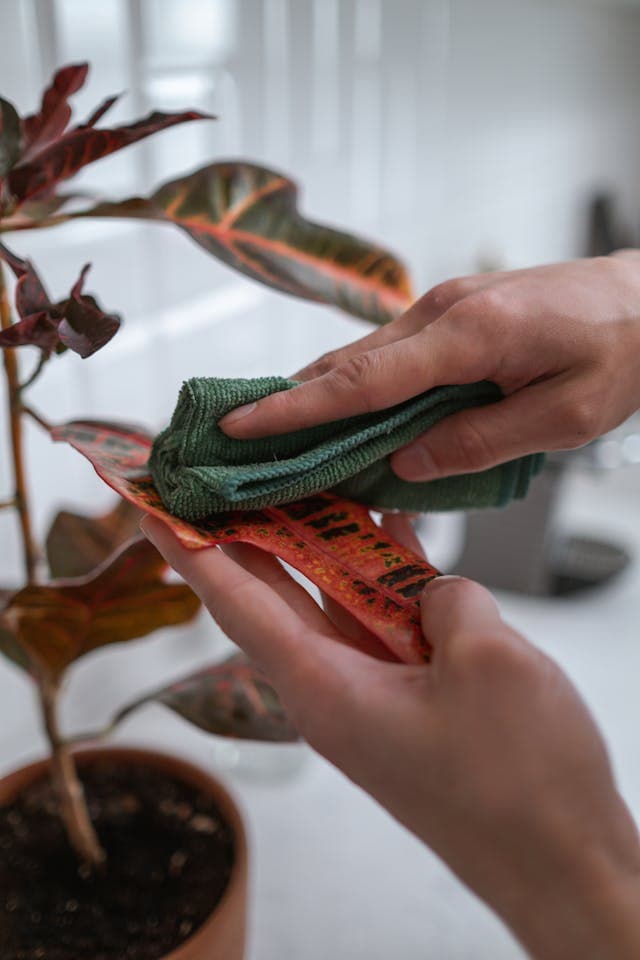
🖐️ Manual Leaf Cleaning: Still the Safest Method We Have
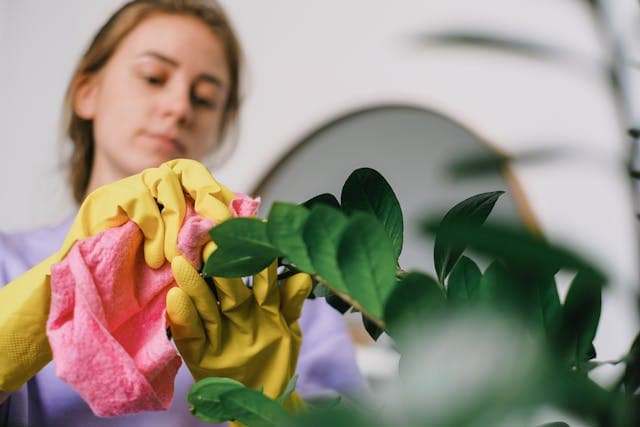
For most houseplants, shrubs, and ornamental plants, nothing works better — or more safely — than cleaning leaves by hand.
It may sound old-fashioned, but this method respects the leaf instead of fighting it.
How to do it the right way:
- Use a soft cotton cloth, microfiber, or sponge
- Dip it in clean, room-temperature water
- Support the leaf gently from underneath
- Wipe slowly from the base toward the tip
- Clean both the top and the underside of each leaf
There’s no need to scrub. Pressure doesn’t equal effectiveness here — gentleness does.
When done properly, this simple act achieves a lot at once:
- Dust lifts off without injuring leaf cells
- The natural waxy coating remains intact
- Fungal spores aren’t splashed or spread
- Early signs of pests are noticed before damage begins
Plants with broader or slightly leathery leaves respond especially well to this care. Rubber plant, monstera, philodendron, hibiscus, ficus, and even curry leaf plants often show visible improvement within a few weeks — deeper colour, firmer leaves, and steadier growth.
What makes this method special isn’t just cleanliness.
It’s connection.
Hand-cleaning forces you to slow down, notice changes, and respond early — long before problems become serious.
In plant care, few things are as effective as paying gentle attention, one leaf at a time. 🌿
🚿 Water Spray Cleaning: Helpful — When Timing and Technique Are Right
Spraying plants with water can be incredibly refreshing for them — but only when it’s done with care and awareness.
This method works best in situations where plants are exposed to open air and regular dust:
- Outdoor garden plants
- Balcony plants facing roads or open spaces
- Large, broad-leaved plants that collect dust easily
- After dry winds or dusty storms
- Early mornings, when leaves are cool and unstressed
Timing and pressure matter more than quantity.
A few important rules keep this method safe and effective:
- Always use gentle water pressure — strong jets damage leaf cells
- Never spray during harsh midday sun, when wet leaves can scorch
- Avoid late evening spraying in humid weather, which encourages fungus
- Let leaves air-dry naturally with good airflow
When done correctly, a soft spray washes away surface dust, insect eggs, and pollution particles while also cooling the plant. It restores leaf breathing space and reduces heat stress — especially important in warm Indian conditions.
What makes this method powerful is that it mimics natural rain. Plants are deeply adapted to respond to rainfall — not just for hydration, but for cleansing and temperature balance.
Used thoughtfully, water spraying feels like relief.
Used carelessly, it becomes stress.
As with most plant care, success lies in gentleness, timing, and restraint 🌿
🌞 When to Clean Plant Leaves (Timing Matters More Than Effort)
Most gardeners focus on how to clean leaves — but when you do it often matters even more.
In Indian conditions, the safest and most effective time is early morning, ideally between 6 and 9 AM.
At this hour, plants are naturally prepared for cleaning:
- Leaves are well-hydrated from the night
- Sunlight is soft, not scorching
- Water dries quickly with rising warmth
- The risk of fungal growth is at its lowest
This window mimics nature’s rhythm — like dew lifting gently as the day begins.
Certain times are best avoided altogether:
- Midday heat, when wet leaves can burn or stress
- Late nights, which trap moisture on leaf surfaces
- Humid evenings, which quietly invite fungal problems
Cleaning at the right time doesn’t need to be frequent.
What matters is consistency, not repetition.
For most plants, a gentle leaf cleaning once every 7–10 days is more than enough to keep leaves breathable, balanced, and healthy — without overhandling or stress.
Plants respond best to care that follows the day’s natural flow.
When you work with their rhythm, they recover faster and grow stronger. 🌿
📊 Leaf Cleaning Guide: Best Practices at a Glance
This guide is meant to simplify decisions. Different plants have different leaf textures, sensitivities, and tolerance levels — so one method doesn’t fit all. Use this as a gentle reference, not a rigid rulebook.
| Plant Type | Best Cleaning Method | Ideal Frequency | Extra Care Tip |
|---|---|---|---|
| Indoor foliage plants | Damp cloth or soft sponge wipe | Every 7–10 days | Always support the leaf from underneath |
| Outdoor shrubs | Gentle water spray | Every 10–15 days | Clean only in the early morning |
| Flowering plants | Soft sponge or cloth wipe | Once a week | Avoid touching buds and open flowers |
| Succulents & cacti | Soft brush or air puff | Once a month | Never soak or wet the leaf surface |
| Herbs | Light water spray | Weekly | Gently shake off excess water after spraying |
This chart works best when paired with observation. If leaves look clean and healthy, don’t clean just for the sake of routine. If dust is visible, respond gently — even if it’s earlier than scheduled.
Leaf care isn’t about strict timing.
It’s about reading the plant and adjusting your touch.
A few mindful minutes, applied correctly, do more than hours of unnecessary effort 🌿
🌱 Succulents and Special Leaves: Where Gentleness Matters Most
Succulents play by different rules.
Their leaves aren’t just for photosynthesis — they’re storage tanks, holding water for dry days ahead. Because of this, excess moisture doesn’t refresh them the way it does other plants. It lingers, seeps in, and can quietly lead to rot.
For these plants, dry cleaning is almost always the safest approach:
- Use a soft makeup brush or artist’s brush
- Lightly dust the leaf surface — no pressure
- Avoid water unless absolutely necessary
- Never wipe or rub aggressively
This gentle care keeps their natural coating intact while removing the dust that blocks light. When succulents are kept clean the right way, they grow more compact, show richer colours, and stay far less vulnerable to disease.
With succulents, restraint is care.
The less you interfere, the better they respond 🌵🌿
🐜 Pest Prevention Begins With Clean Leaves
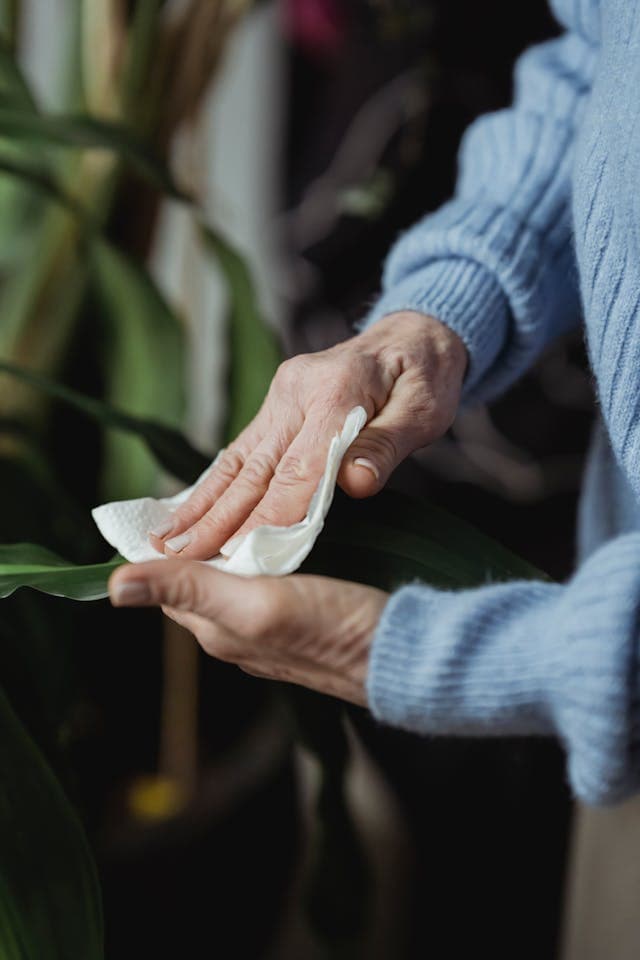
Most pests don’t target healthy, comfortable plants.
They look for stressed ones — plants that are already struggling to breathe and regulate themselves.
Dirty leaves create the perfect invitation:
- Spider mites settle easily on dusty surfaces
- Aphids are drawn to sticky residue
- Whiteflies hide and multiply unnoticed
- Early infestations remain invisible until damage spreads
Regular leaf cleaning quietly breaks this cycle.
When leaves are kept clean:
- Many pests are removed before they can breed
- Eggs are wiped away mechanically, without chemicals
- Early signs of trouble are noticed immediately
- The need for sprays and harsh treatments drops dramatically
A clean leaf is not just a cosmetic improvement —
it’s a form of preventive protection.
By keeping the leaf surface breathable and visible, you turn routine care into the first line of defense — long before pests ever gain a foothold 🌿
🌿 The Quiet Shift: When Leaves Become Something You Notice
Once this habit settles in, something changes — not just in the plants, but in the gardener.
Plants stop feeling like background objects.
Your eyes begin to notice texture, temperature, softness, and shine.
Your hands recognize when a leaf feels tired instead of healthy.
Stress is detected earlier, before damage has time to spread.
Care turns from reaction into awareness.
This isn’t about emotion or belief — it’s biology responding to attention. Clean leaves function better. Leaves that function well feed the entire plant more efficiently. And plants that are supported at the leaf level grow stronger, steadier, and more resilient over time.
What grows isn’t just foliage.
It’s understanding, patience, and a relationship with living growth — one leaf at a time 🌱
🌼 What Regular Leaf Cleaning Changes Over Time
The real benefits of leaf cleaning don’t appear in a single week.
They reveal themselves slowly, over months — quietly but consistently.
Gardeners who keep this habit notice meaningful shifts:
- New leaves emerge faster and with more confidence
- Green tones deepen and stay richer for longer
- Flowering becomes more reliable and balanced
- Dependence on fertilizers naturally reduces
- Disease outbreaks become less frequent
- Plants handle seasonal changes with greater strength
Nothing dramatic is added to the routine.
No new product is introduced.
The plant simply works more efficiently because its most important surface is no longer obstructed.
This habit costs nothing, takes very little time, and yet delivers results that last — not because it forces growth, but because it removes what was quietly holding growth back 🌿.
🌱 A Message Written in Green
Plants don’t ask for much.
They don’t demand perfection.
They don’t need constant feeding or correction.
They only ask for the space to breathe.
When you clean a leaf, you aren’t performing a cosmetic task — you’re restoring the most basic function of life. Light enters more easily. Air moves freely. Energy begins to flow again.
Growth doesn’t start with more effort.
It starts where breathing becomes effortless.
A plant rarely grows weak because it was ignored.
It grows weak when its quiet signals are buried under layers of dust.
And sometimes, the most meaningful care isn’t about adding something new —
it’s about gently clearing the way 🌿

