
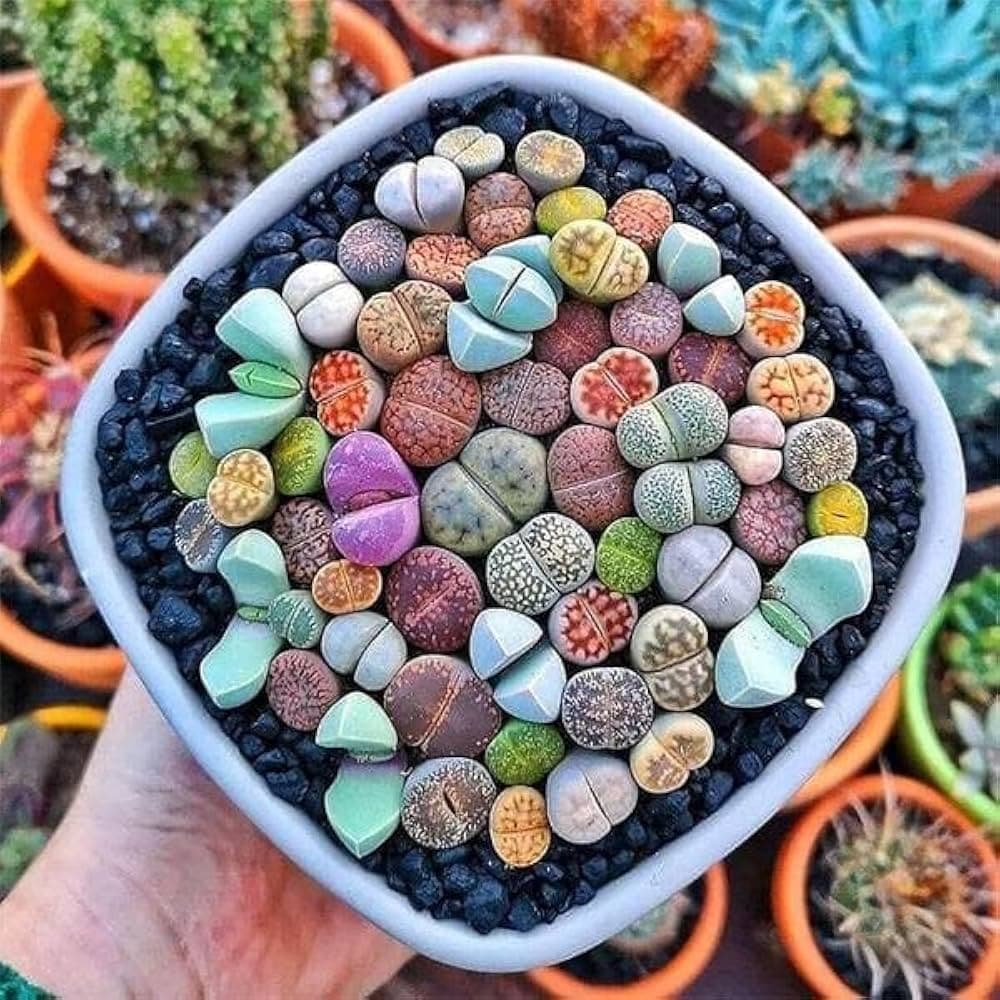
Among succulents, Lithops feel like a quiet illusion rather than a plant. You don’t notice them immediately. In fact, most people walk right past them, mistaking them for cracked pebbles or forgotten bits of gravel resting on dry soil. They don’t stretch upward. They don’t wave leaves in the air. They sit still—patient, almost invisible—pretending to be nothing more than stone.
And then, without warning, something extraordinary happens. From the narrow slit between those “stones,” a soft daisy-like flower slowly rises—pure white or sun-washed yellow—proving that what looked lifeless was alive all along. That single bloom feels almost magical, as if the desert itself decided to speak.
Lithops are more than unusual succulents. They are a masterclass in survival, shaped by harsh landscapes, extreme patience, and nature’s most brilliant disguise. This article dives into their true identity—their science, origin, fascinating varieties, and a realistic care approach—with special attention to Indian growing conditions. Because understanding Lithops isn’t about forcing growth; it’s about learning when not to interfere.
🌍 Scientific Identity & Common Names
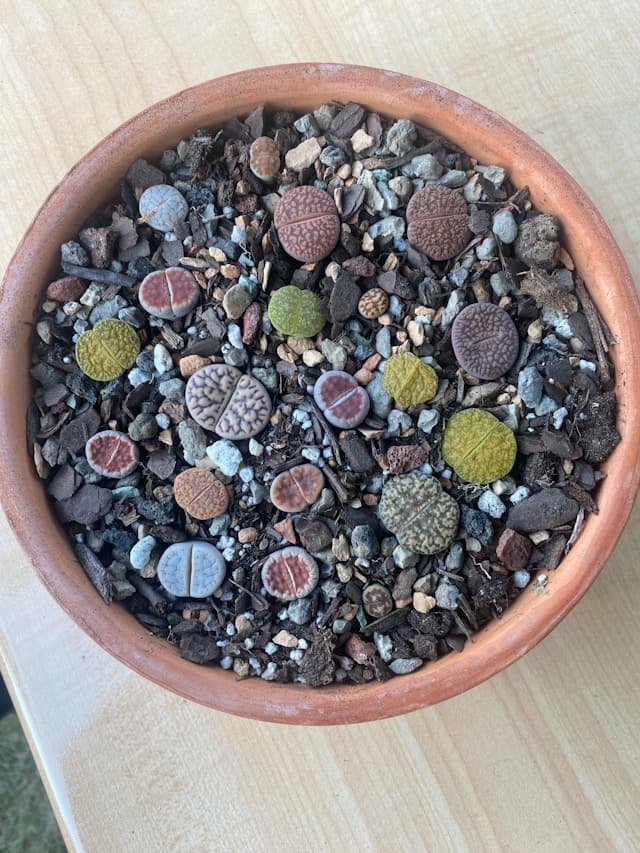
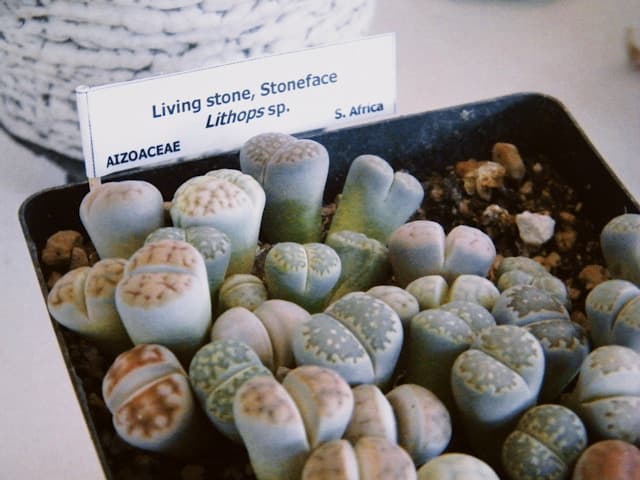
Botanically, these strange little survivors belong to the genus Lithops, part of the Aizoaceae family—a group of plants built for extremes rather than comfort. But very few people remember them by their scientific label. What stays in the mind are the names they earned by deception.
They are called Living Stones, Pebble Plants, Stone Mimic Plants, and even Flowering Stones—each name reflecting the same truth: these plants survive by not looking like plants at all.
The word Lithops itself tells their story. It comes from two ancient Greek roots: “lithos,” meaning stone, and “ops,” meaning face. Put together, the name translates to “stone-faced.” It’s not poetic exaggeration—it’s biological accuracy.
Lithops didn’t choose beauty to survive. They chose invisibility. By evolving to resemble the rocks around them, they escaped grazing animals, scorching sun, and harsh desert winds. What we admire today as uniqueness began as a desperate strategy to stay alive.
🌱 Origin & Natural Habitat
Lithops come from some of the most unforgiving landscapes on Earth. Their native home lies in Namibia, Botswana, and parts of South Africa—regions where survival is never guaranteed.
These are lands shaped by scarcity. Rain arrives rarely and without warning. Sunlight is relentless. Days burn hot, while nights can turn unexpectedly cold. In such places, plants that grow tall or flashy don’t last long. Lithops survived by choosing a different path altogether: they disappeared into the landscape.
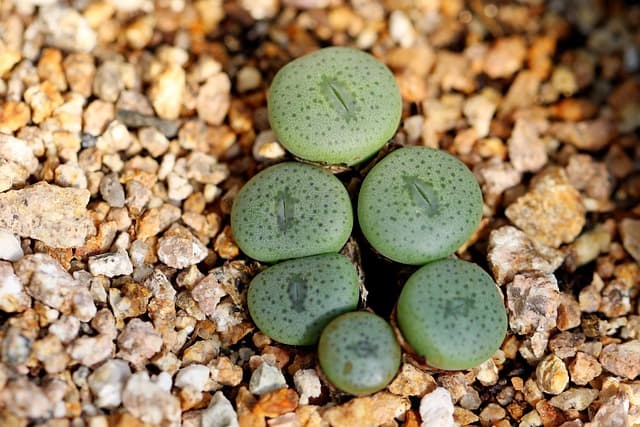
Rather than rising above the soil, Lithops grow low and still, nestled among gravel and stones, often half-buried. At a distance, even trained eyes struggle to tell where rock ends and plant begins. This is not weakness—it is precision.
Why Do Lithops Look Like Stones?
Their stone-like form isn’t a coincidence or an aesthetic trick. It’s a carefully evolved survival strategy known as mimicry.
By blending seamlessly into gravel beds:
- Grazing animals overlook them completely
- Their tiny exposed surface slows precious water loss
- Most of the plant body stays protected beneath the soil, away from extreme heat
Only the very top remains visible. This exposed section is called a “window.” It’s slightly translucent, allowing sunlight to filter inside for photosynthesis—while the rest of the plant stays safely hidden underground. Lithops don’t chase the sun. They let it come to them, quietly and in moderation.
In nature, Lithops teach a powerful lesson: sometimes survival isn’t about growing stronger or faster—it’s about knowing when to stay unseen.
🧬 Unique Structure & Growth Habit
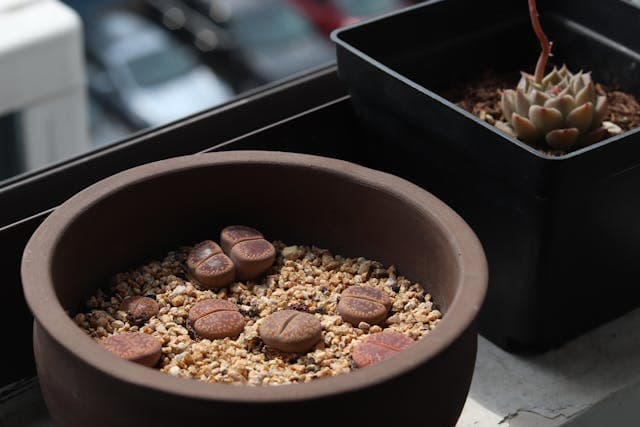
Lithops break almost every rule we associate with plants. There are no visible stems. No clusters of leaves. No branching growth. What you see is almost all there is.
Each Lithops plant is made of just one pair of thick, fleshy leaves, fused together like two stones pressed side by side. Between them lies a narrow opening called the fissure—a small but powerful space. This single slit is the plant’s only doorway to the outside world.
Everything important happens here. Flowers rise from it. New leaves emerge from it. Life enters and exits through this quiet opening, while the rest of the plant remains still and protected.
Lithops don’t grow outward.
They renew themselves inward.
The Annual Leaf Replacement Cycle
This is where Lithops truly separate themselves from ordinary succulents.
Once a year, something unusual begins. The old pair of leaves doesn’t fall off or get trimmed away. Instead, it slowly starts to collapse. Day by day, it shrinks and wrinkles, as if the plant is retreating into itself.
Inside those dying leaves, a new pair is forming.
As the inner leaves grow, they draw moisture and nutrients directly from the old ones. The outer pair eventually dries into a paper-thin shell, having given everything it had. And here’s the most important part—this entire transformation happens without watering.
Watering during this phase can interrupt the cycle and harm the plant. In nature, Lithops evolved to survive drought by recycling themselves. This yearly renewal isn’t optional; it’s essential to their survival.
Lithops don’t chase growth.
They wait, shed, and quietly begin again.
🌼 Flowering: A Surprise from Stone
When a Lithops blooms, it never feels ordinary. It feels earned.
For most of the year, these plants sit quietly, doing almost nothing that looks impressive. And then—often when the garden feels calm and restrained—something unexpected happens. In Indian conditions, Lithops usually bloom from late autumn to early winter (October to December), just as many other plants slow down.
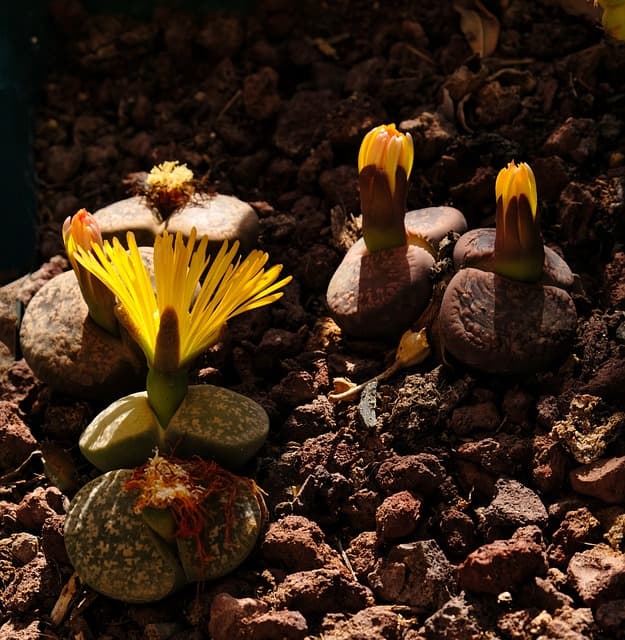
From the narrow fissure between the leaves, a flower slowly rises. It looks almost unreal against the stone-like body beneath it.
What the Flower Is Like
The bloom resembles a miniature daisy—simple, clean, and perfectly placed.
- Colors are usually white or soft yellow
- Flowers open fully during daylight
- They close again at night, repeating this rhythm for several days
The contrast is striking: a soft, delicate flower emerging from something that looks like a rock. It’s this moment that makes people fall in love with Lithops.
Why Some Lithops Bloom—and Others Don’t
Flowering isn’t guaranteed. Lithops bloom only when they feel completely secure.
It happens when:
- The plant has reached maturity (usually 3–4 years old)
- Sunlight has been strong and consistent
- Watering was restrained and well-timed throughout the year
There’s no shortcut here. Extra fertilizer won’t help. More water won’t speed things up. A Lithops flowers only when it has been understood, not pushed.
A blooming Lithops doesn’t feel like a victory of technique.
It feels like a quiet thank-you—for patience, restraint, and trust.
🌈 Popular Lithops Varieties
The world of Lithops is far richer than most people expect. There are over 40 recognized species, along with hundreds of natural forms shaped by local soils, stones, and light. No two plants look exactly the same—even within the same species. That’s part of their quiet magic.
Below are some of the most loved and widely grown Lithops, especially among home growers.
🌑 Lithops aucampiae
This species often wears warm earthy tones—brown, copper, or soft red, blending effortlessly into gravel-like soil. The bodies are slightly larger and sturdier than many others, which makes it forgiving and beginner-friendly. When it blooms, the contrast feels bold and confident.
🌕 Lithops lesliei
One of the most familiar and widely cultivated Lithops. Its appeal lies in variety—grey, green, rust, and even muted pink shades can appear within the same species. It reliably produces bright yellow flowers, making it a favorite for those seeing Lithops bloom for the first time.
🌾 Lithops hookeri
Recognizable by its larger heads and striking surface patterns, this species looks like carefully etched stone. It prefers conditions on the drier side and rewards restraint. Overwatering dulls its beauty, but dry care keeps its markings sharp and defined.
🌫 Lithops julii
Subtle and elegant, this variety features a grey-white base crossed with fine, web-like lines, resembling cracked marble or weathered limestone. It doesn’t shout for attention—but once noticed, it’s hard to forget.
🌸 Lithops optica ‘Rubra’
This one feels almost unreal. With soft pink to deep purple tones, it stands apart from the usual stone palette. It grows very slowly and is highly sensitive to excess water, making it better suited for patient, experienced growers.
Every Lithops variety is shaped by the stones it once hid among. Their colors, lines, and textures are not decoration—they are memory. That’s why growing Lithops never feels like collecting plants. It feels like preserving pieces of a landscape.
🌱 Propagation of Lithops: Growing Living Stones from Seed & Division
Propagating Lithops is not about speed or shortcuts—it’s about patience and restraint. These plants follow desert time, not human time. Unlike many succulents, Lithops cannot be multiplied casually. No leaf cuttings. No quick tricks. Their growth follows rules shaped by harsh landscapes.
In nature, Lithops reproduce mainly through seeds, and only occasionally by forming clusters over many years. Understanding this difference saves growers from disappointment—and from harming the plant.
🌾 Seed Propagation (The Truest and Most Reliable Method)
Growing Lithops from seed is slow, but it is also the most natural and successful approach. It mirrors how these plants have survived for thousands of years.
For best results:
- Use a sterilized, mineral-rich soil mix with very fine grit or sand
- Sow seeds on the surface—never bury them
- Keep moisture light and controlled using gentle misting, not direct watering
- Place seedlings in bright, indirect light
Under warm conditions, germination usually begins within 7 to 21 days. At first, seedlings look nothing like stones. Their true form develops slowly, season by season.
Seed-grown Lithops often take 3–4 years to flower, but they grow stronger, adapt better to local climates, and live longer. This slow beginning is not a disadvantage—it’s a foundation.
🌱 Division (Only for Mature, Naturally Clumped Plants)
Some Lithops species form clusters—but only after many years of stable growth. Division is possible, but it should never be rushed.
Division works only when:
- Each head has its own independent root system
- The plant is fully mature and healthy
- The timing is right—early spring, during active growth
Dividing young or stressed plants almost always causes setbacks. This method is best left to experienced growers who understand Lithops rhythms.
🚫 What Simply Does Not Work
Some methods fail because Lithops are not built like ordinary succulents:
- Leaf cuttings ❌
- Stem cuttings ❌
- Water propagation ❌
Lithops are living stones. They don’t regenerate from fragments. They continue from wholeness—or not at all.
Propagation teaches the same lesson Lithops always do:
growth happens when conditions are respected, not when they are forced.
🌞🌱 Growing Lithops in the Indian Climate
Growing Lithops in India is not difficult—but it is different. These plants don’t fail because of climate alone; they fail when we try to grow them like regular succulents. Once their natural rhythm is respected, Lithops adapt surprisingly well to Indian conditions.
🌡 Temperature: Heat Is Fine, Humidity Is Not
Lithops are comfortable within a 18–32°C range, which already matches much of India for most of the year. They can tolerate even higher temperatures—but only when the soil is completely dry.
What they dislike most is warmth combined with moisture.
- Dry heat: ✔️ manageable
- Cool dryness: ✔️ ideal
- Heat + wet soil + humidity: ❌ dangerous
During the monsoon, protection becomes critical. Constant humidity and damp soil can quickly lead to rot, even if the plant looks fine on the surface.
☀️ Sunlight: Bright, Gentle, and Consistent
Lithops need strong light, but not burning exposure.
- 4–6 hours of morning sun works best
- Bright, filtered light for the rest of the day
- Avoid harsh afternoon summer sun, especially in North and Central India, where intensity spikes
For indoor growers, east- or south-facing windows are ideal. The goal is clarity, not punishment. When light is right, Lithops stay compact, patterned, and healthy. When light is weak, they stretch and lose their stone-like form.
Lithops don’t ask for luxury—only alignment.
Give them dryness when they expect it, light when they need it, and silence when they’re resting.
🪴 Soil: The One Factor That Decides Survival
If Lithops fail, soil is almost always the reason.
These plants are not adapted to comfort. Regular potting soil—even mixes sold for succulents—holds moisture for too long and quietly suffocates Lithops roots. What they need is not nutrition-rich soil, but fast, ruthless drainage.
Ideal Soil Mix (Suited for Indian Conditions)
A Lithops soil mix should feel more like gravel than earth:
- 50–60% coarse sand, grit, or pumice
- 20–30% perlite or crushed brick
- 10–20% very light garden soil
This balance mimics the stony ground Lithops evolved in—where water disappears almost as soon as it arrives.
What the Soil Must Do
Good Lithops soil should:
- Drain instantly—within seconds, not minutes
- Never stay moist beneath the surface
- Allow air to move freely around the roots
If soil stays damp even a day too long, the plant doesn’t complain—it simply begins to rot from the inside.
Why Clay Pots Matter
Clay or terracotta pots are strongly recommended. They breathe, release excess moisture, and help keep the root zone dry. Plastic pots trap humidity and prolong wetness—two things Lithops cannot tolerate.
Lithops don’t grow in soil.
They rest between stones.
Your soil should feel like a place water can’t stay.
💧 Watering: Where Most People Fail
Lithops don’t die from neglect.
They die from too much care.
Watering feels kind, but for Lithops, it’s a decision that must be earned by the season—not by habit. These plants store water inside their bodies and expect long dry pauses. When we interrupt that rhythm, damage happens quietly and irreversibly.
Seasonal Watering Guide (Indian Conditions)
Think of watering Lithops as seasonal permission, not a routine.
🌱 Spring (February–March)
This is a cautious phase.
- Water only if the soil is bone dry
- One light watering is usually enough
- If unsure, wait
☀️ Summer (April–June)
Lithops mostly rest.
- Keep the soil dry
- Water once in 4–6 weeks only if deep shriveling appears
- Mild surface wrinkles are normal—don’t panic
🌧 Monsoon (July–September)
This is the danger season.
- No watering at all
- Keep plants dry, airy, and protected from humidity
- Good ventilation matters more than sunlight now
🍂 Autumn–Winter (October–December)
Life returns—but gently.
- Resume very light watering after flowering
- Stop watering again as soon as new leaves begin forming inside
🚫 The One Rule That Saves Lives
Never water Lithops when old leaves are drying or shrinking.
During leaf replacement, the plant is already feeding on stored moisture from the old leaves. Adding water at this stage confuses the cycle, causes splitting, or leads to rot.
Lithops don’t ask, beg, or signal loudly.
They expect you to know when to step back.
Water less than you think.
Wait longer than feels comfortable.
That’s how Lithops survive—and thrive.
🌬 Humidity & Air Circulation: The Silent Threat
In India, humidity is often more dangerous to Lithops than heat or sunlight.
These plants evolved in dry, open landscapes where air is always moving. When they’re placed in closed rooms or damp corners, moisture lingers around the plant body—even if the soil looks dry. That trapped moisture is enough to start rot.
How to Keep Lithops Safe
- Avoid closed, poorly ventilated rooms
- Choose open balconies, airy shelves, or windows with regular airflow
- Indoor growers should keep windows open whenever possible
One Habit to Break Immediately
Never mist Lithops.
Misting raises surface humidity without benefiting the roots—and Lithops absorb almost nothing through their skin. What misting does add is risk.
When in doubt, remember this rule:
Dry air is always safer than moist air.
Lithops don’t need pampering.
They need space, air, and the freedom to dry completely.
🌱 Pot Size & Repotting: Less Space, Less Stress
Lithops don’t want room to roam.
They want stability.
Because their root systems are compact and shallow, deep pots are unnecessary and often harmful. What matters more is balance—not size.
Choosing the Right Pot
- Shallow pots are more than enough
- Wide containers work well, especially for mature plants or small clusters
- Extra depth only traps moisture where roots don’t need it
A slightly snug pot helps the soil dry faster and keeps the plant grounded.
When (and When Not) to Repot
Lithops dislike frequent disturbance.
- Repot only once every 2–3 years, or when the soil has broken down
- Always repot during the active growing season
The worst time to repot is during leaf replacement. At that stage, the plant is already redirecting its energy inward. Disturbing the roots then can interrupt the cycle and slow recovery.
Repotting Lithops is not maintenance—it’s intervention.
Do it rarely, do it gently, and do it at the right time.
🐛 Pests & Problems: Reading the Quiet Warnings
Lithops are naturally resilient. Their stone-like bodies protect them from many common pests—but when problems appear, they usually come from environmental mistakes, not insects.
Issues You May Encounter
- Mealybugs, especially around the roots, where they remain hidden
- Fungal rot, almost always caused by excess moisture or poor airflow
- Splitting, a sign of overwatering or watering at the wrong time
These problems don’t arrive suddenly. Lithops always give small signals first.
How to Read a Healthy Lithops
A healthy plant feels:
- Firm to the touch
- Matte, not glossy
- Compact and symmetrical, like a well-set stone
Warning signs are subtle but serious:
- Soft or spongy bodies
- Translucent or waterlogged appearance
- Sudden swelling or unnatural splitting
When Lithops look unwell, the solution is rarely “do more.”
It’s almost always do less—less water, less handling, less intervention.
Lithops survive by balance.
Once that balance is disturbed, they don’t fight back loudly—they fade quietly.
🌿 Lithops Plant Care & Growing Requirements (Indian Climate)
| Growing Factor | Ideal Requirement for Lithops | India-Specific Insight |
|---|---|---|
| Scientific Identity | Lithops species (Aizoaceae family) | True succulents adapted to extreme dryness |
| Common Names | Living Stones, Pebble Plants | Often mistaken for decorative stones—by design |
| Sunlight | Bright light, 4–6 hours daily | Morning sun is safest; harsh summer afternoons can scorch |
| Temperature | 18–32°C | Can handle Indian heat only when soil is completely dry |
| Soil Type | Extremely fast-draining, gritty mix | Regular garden soil almost always leads to rot |
| Pot Type | Clay or terracotta pots | Helps moisture escape quickly—plastic traps humidity |
| Water Requirement | Very low | Overwatering is the most common cause of death |
| Humidity | Low humidity preferred | Protect carefully during monsoon months |
| Air Circulation | Excellent airflow essential | Open windows, balconies, airy shelves work best |
| Growth Speed | Extremely slow | This is normal—forcing growth causes damage |
| Flowering Season | October–December (India) | Only mature, well-grown plants will bloom |
| Leaf Renewal | Once per year | Never water during this phase |
| Lifespan | Several decades | With correct care, Lithops can outlive many houseplants |
This chart highlights one core truth:
Lithops don’t fail because they are delicate—they fail because they are misunderstood.
Grow them like stones with patience, not like houseplants with schedules.
💧 Lithops Seasonal Watering & Growth Cycle (Indian Climate)
| Season | What the Plant Is Doing | Watering Rule | What Matters Most |
|---|---|---|---|
| Spring (Feb–Mar) | Waking up and growing slowly | Light watering only if soil is completely dry | Never soak the soil—Lithops dislike excess even in growth |
| Summer (Apr–Jun) | Semi-dormant, conserving energy | Optional: once in 4–6 weeks only if deep shriveling appears | Heat is not the enemy—wet soil is |
| Monsoon (Jul–Sep) | Fully dormant | ❌ No watering at all | Protect from rain, humidity, and trapped moisture |
| Autumn (Oct–Nov) | Flowering stage | Gentle watering after flowering ends | This is the reward season—do not rush it |
| Winter (Dec–Jan) | Leaf replacement (internal renewal) | ❌ No watering | Old leaves must dry and feed the new ones |
This cycle explains why Lithops confuse so many growers.
They don’t follow calendars—they follow internal seasons.
When unsure, remember this guiding thought:
If Lithops are quiet, still, and firm—leave them alone.
⚠️ Common Lithops Problems & Gentle Solutions (Read Before You React)
Lithops rarely collapse overnight. They communicate quietly—through texture, firmness, and timing. Most problems are not emergencies; they are signals.
| What You Notice | How It Looks | What’s Really Happening | Gentle, Correct Response |
|---|---|---|---|
| Soft or mushy body | Plant feels squishy or translucent | Too much water trapped inside | Stop watering immediately, improve drainage and airflow |
| Plant splitting open | Leaves burst unnaturally | Watering during the wrong season | Let soil dry completely; do not water again for weeks |
| Wrinkled surface | Deep wrinkles, sunken look | Mild dehydration (not always bad) | Light watering only if not in leaf-replacement stage |
| No flowers | Plant looks healthy but never blooms | Plant is too young or light is weak | Increase light, wait for maturity—don’t force |
| Rot at the base | Dark, soft, or smelly tissue | Poor drainage or lingering moisture | Repot into completely dry, gritty soil |
| Shriveled old leaves | Dry, papery outer leaves | Normal annual leaf replacement | ❌ Do not water—this is expected and healthy |
| Mealybugs | White cotton-like patches | Poor airflow or hidden root pests | Remove manually; keep soil dry and airy |
| Fungal issues | Black spots, mold, or decay | High humidity + wet soil | Improve ventilation and stop watering |
One Rule That Solves Most Problems
If a Lithops looks quiet, firm, and still—do nothing.
Lithops suffer not from neglect, but from interruption.
Observe first. Act slowly. Let the plant finish its own cycle.
🪴 Ideal Pot Size & Plant Spacing: Giving Stones the Right Distance
Lithops don’t like crowding—but they also don’t like excess space. Too much soil holds moisture. Too little room restricts natural growth. The right pot size creates balance and keeps the root zone safely dry.
| Plant Stage | Recommended Pot Size | Why This Works |
|---|---|---|
| Single Lithops | 6–8 cm pot | Limits excess soil moisture and helps the mix dry quickly |
| Small Cluster (2–4 heads) | 10–12 cm pot | Gives space for natural clumping without trapping water |
| Mature Group | Wide, shallow bowl | Mimics natural stone fields where Lithops spread sideways |
A Quiet Rule to Remember
Lithops grow sideways, not deep. That’s why shallow containers always outperform tall ones. Extra depth adds nothing—but extra width allows the plant to behave naturally.
Spacing isn’t about decoration.
It’s about airflow, dryness, and respecting how Lithops choose to exist.
🌱 Gentle Reminder for Growers
Lithops were never meant to fit into human routines.
They don’t respond to weekly watering plans, fixed calendars, or constant attention. They follow desert logic—a rhythm shaped by scarcity, silence, and waiting.
Every chart above points to the same quiet truth:
“Less water.
More light.
And an abundance of patience.”
When cared for correctly, Lithops don’t reward urgency.
They reward understanding.
Leave them alone when they are resting.
Trust them when they look unchanged.
And one day, from what appears to be nothing more than stone, they will bloom—slowly, honestly, and without announcement.
“Some plants grow to impress.
Lithops grow to endure.”
🧘 A Plant That Teaches Patience
Lithops are not decorative fillers, and they were never meant to grow fast.
They move slowly, exist quietly, and demand almost nothing—except restraint.
They teach growers to observe instead of interfere,
to wait instead of react,
and to trust processes that don’t announce themselves.
In a world trained to expect instant results, Lithops offer a different lesson—one rooted in stillness rather than speed.
“Sometimes survival isn’t about growing bigger or faster.
It’s about staying still, blending in, and waiting for the right moment.”
Lithops don’t reward effort.
They reward understanding.
They don’t bloom for attention.
They bloom when patience has been practiced long enough.

