
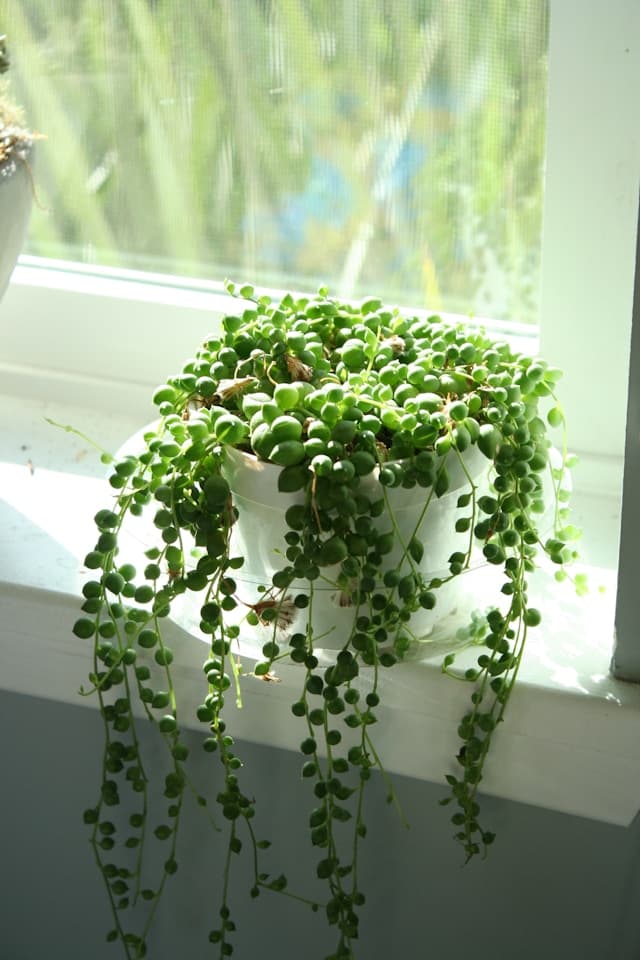
The String of Pearls plant is often sold as a beginner’s dream—an elegant cascade of green beads spilling over pots, marketed as a “set it and forget it” succulent. Garden centers confidently tag it as easy, social media feeds overflow with flawless trailing displays, and sellers casually suggest that this plant actually prefers neglect.
But inside real homes, a very different story unfolds.
In thousands of households, String of Pearls doesn’t fail loudly—it fades quietly. The pearls begin to wrinkle, stems soften near the soil line, healthy trails suddenly collapse, and rot appears without warning. What confuses plant owners most is the speed of decline. One week it looks fine, the next it seems beyond saving. Naturally, people blame themselves for killing a plant that was never supposed to be difficult.
Here’s the uncomfortable truth most care guides avoid:
String of Pearls is not an easy indoor plant—it is a deeply misunderstood one.
This article pulls apart that misunderstanding layer by layer. It explains why String of Pearls struggles indoors, why these failures are especially common in Indian homes, and what this plant actually needs—not to merely survive for a few months, but to live long-term without constant disappointment.
🌿 The Origin of the “Easy Plant” Label
Why Nurseries Call It Easy
String of Pearls earns the easy label not because it is effortless to grow—but because it behaves beautifully at the moment of sale.
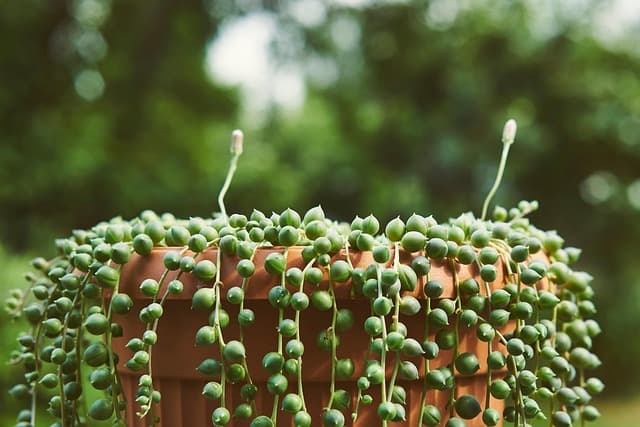
In nurseries and garden centers, this plant appears almost problem-free. It looks compact, fresh, and full of plump green beads. It doesn’t demand daily watering, and since it belongs to the succulent family, people automatically associate it with toughness and resilience. On paper, it checks all the boxes of a beginner-friendly plant.
What this label quietly ignores is a crucial reality:
nursery conditions and home conditions are worlds apart.
Most String of Pearls plants sold in markets are not mature, settled plants. They are usually:
- Young, recently propagated cuttings
- Grown in fast-draining soil under professional care
- Kept in bright light, constant airflow, and controlled humidity
In these environments, the plant isn’t being tested—it’s being protected.
The moment it enters a home, everything changes. Light becomes weaker, air stops moving, humidity fluctuates, and watering habits shift. The plant is suddenly expected to adapt without the gradual transition it needs. This silent shock is where most failures begin—not because the owner is careless, but because the plant was never truly “easy” to begin with.
🌿 Botanical & Growth Information: String of Pearls
Scientific Name:
Curio rowleyanus
(previously classified as Senecio rowleyanus)*
Common Names:
String of Pearls
Pearl Plant
Bead Plant
Botanically, String of Pearls belongs to a small group of succulents that evolved not to stand upright, but to trail, spill, and creep along the ground. Its scientific reclassification—from Senecio to Curio—reflects a better understanding of its growth behavior and structural differences from typical upright succulents.
The iconic “pearls” are not decorative accidents. Each bead-shaped leaf is a water-storage organ, designed to survive dry periods while minimizing surface area to reduce moisture loss. A faint translucent stripe on each pearl allows light to penetrate deep into the leaf, enabling photosynthesis without exposing too much surface to harsh sun.
This unique structure explains both its beauty and its sensitivity. What evolved to trail across open, airy ground struggles when forced to sit still in low light, heavy soil, or stagnant indoor air—conditions that are common inside homes but completely foreign to its natural design.
🌍 Country of Origin
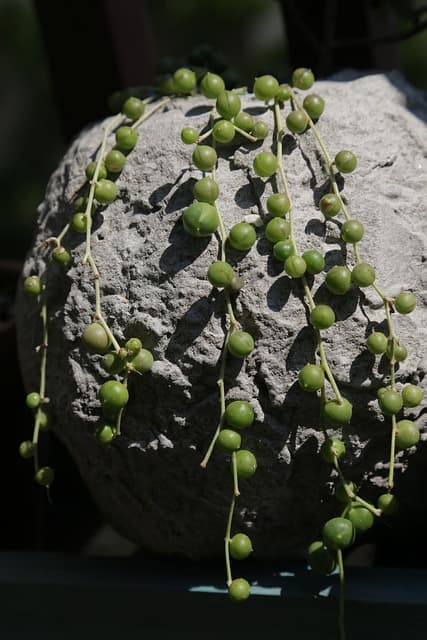
String of Pearls is native to South Africa, where it grows in dry, rocky landscapes shaped by strong airflow, bright light, and long gaps between rainfall. In these regions, moisture never lingers around the roots, and the air remains constantly moving—conditions that prevent rot before it can even begin.
This natural background explains a lot about the plant’s behavior indoors. When placed in humid rooms, closed balconies, or poorly ventilated corners, String of Pearls is forced into an environment it was never designed for. Moisture hangs in the air, soil stays damp longer than it should, and airflow drops to near zero—creating exactly the conditions that lead to stem rot and sudden collapse.
The plant isn’t weak indoors—it’s simply out of context.
🌡️ Temperature Tolerance
| Temperature Range | Plant Response |
|---|---|
| Ideal Range | 15°C – 28°C |
| Minimum Tolerable | Around 5°C (short periods only) |
| Maximum Tolerable | Around 35°C (with dry soil & airflow) |
⚠️ Prolonged exposure below 5°C or above 38°C, especially with moisture, can cause irreversible damage.
🌱 Why String of Pearls Is Different From Other Succulents
Many people care for String of Pearls the same way they treat aloe, jade, or haworthia. That single assumption is often what kills the plant.
1. Its Pearls Are Water Storage Units — Not Decorative Leaves
Each round “pearl” is actually a highly specialized, modified leaf designed to store water for long dry periods. This isn’t a visual quirk—it’s a survival strategy. Even more telling is the faint translucent strip running across every bead. That window allows light to reach the interior of the leaf while keeping surface exposure low, reducing evaporation in harsh conditions.
In other words, this plant is built to hold water efficiently and release it slowly.
What this means for real-world care is often misunderstood:
- The plant already carries its own water reserve
- Frequent watering floods a system that isn’t empty yet
- Excess moisture doesn’t just sit in the soil—it overwhelms the internal cells
When those cells rupture from too much water, the pearls collapse from the inside out. What looks like sudden shriveling or rot is actually internal damage that started days—or weeks—earlier.
String of Pearls doesn’t die because it’s thirsty.
It dies because it was watered before it needed it.
2. It Has Extremely Shallow Roots
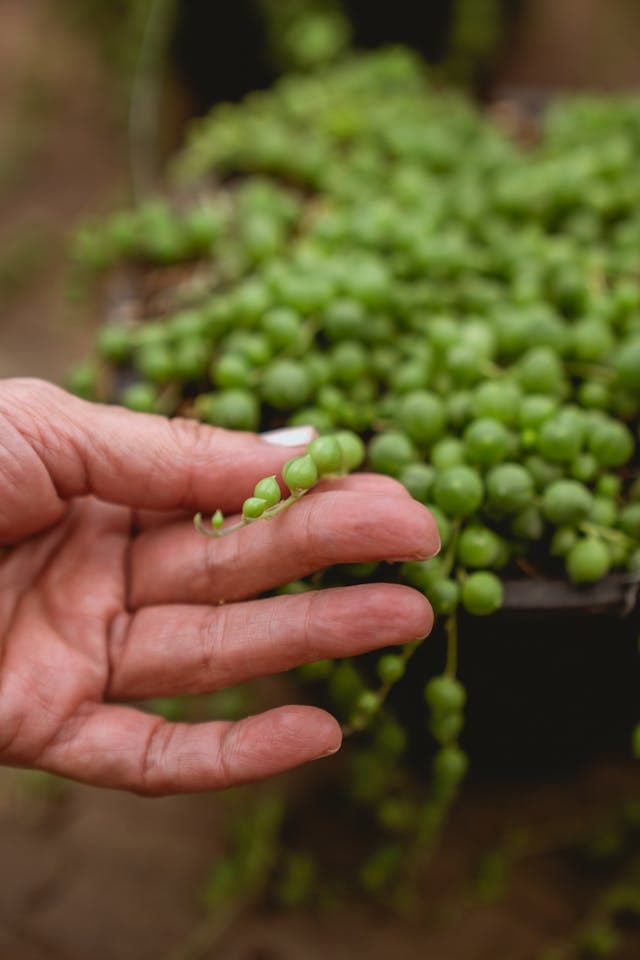
Unlike many houseplants, String of Pearls does not develop deep, searching root systems. Its roots stay close to the surface and exist mainly to anchor the plant in place, not to absorb large amounts of water from wet soil.
This detail changes everything about how the plant should be treated.
The moment soil stays moist for too long:
- Shallow roots lose access to oxygen
- They suffocate quickly instead of slowly adapting
- Rot sets in before the plant can signal distress
Poor drainage doesn’t cause gradual decline here—it triggers rapid underground damage. By the time you notice soft pearls or collapsing trails, the root system has often already failed.
3. Growth Begins — and Ends — at the Soil Surface
With String of Pearls, all healthy trailing growth depends on one fragile point: the crown at the soil surface. This is where new roots form, where energy is distributed, and where the plant decides whether it can continue growing.
If this base area becomes weak—due to excess moisture, fungal activity, or lack of airflow—the entire plant collaps. Even if the trailing strands still look green for a while, the support system is gone.
This is why String of Pearls so often appears to “die suddenly.”
The failure didn’t happen overnight—it started silently at the soil line, long before the damage became visible.
🚫 The Real Reasons String of Pearls Fails Indoors
❌ 1. Overwatering — Even “Careful” Watering
The most common mistake isn’t heavy watering—it’s watering lightly but often.
Indoors, water behaves very differently than it does outdoors or in nurseries. Evaporation slows down because there’s:
- No direct sun to dry the soil
- Limited airflow around the pot
- Naturally higher indoor humidity
As a result, soil that looks dry on the surface can stay damp underneath for days.
Early warning signs are subtle but telling:
- Pearls turn soft, dull, or slightly translucent
- Stems feel mushy right at the soil line
- Pearls detach with the lightest touch
By the time these symptoms are visible, the damage has already started underground. Root rot doesn’t announce itself early—it develops quietly, then shows up all at once.
This is why String of Pearls often fails even in the hands of careful plant owners. The plant wasn’t overwatered aggressively—it was watered before it had fully used what it already stored.
❌ 2. Misunderstanding What “Bright Light” Actually Means
Many growers believe placing the plant in a “bright room” is enough. Unfortunately, brightness to human eyes and usable light for plants are not the same thing.
String of Pearls needs:
- Bright, indirect sunlight
- Gentle morning sun (optional, but very beneficial)
- Protection from harsh afternoon exposure
Common indoor light mistakes include:
- Keeping the plant several feet away from windows
- Blocking natural light with thick curtains or tinted glass
- Relying on tube lights or regular bulbs
When light is insufficient, the plant doesn’t die immediately—it weakens slowly:
- Pearls begin to shrink instead of staying plump
- Stems stretch unnaturally and lose strength
- New growth either stalls or stops completely
Without enough light, the plant can’t balance the water it stores, making it even more vulnerable to rot.
❌ 3. The Indian Climate Factor Most Care Guides Ignore
Indian homes create a perfect storm for String of Pearls failure.
Between:
- Extremely hot summers
- Long, moisture-heavy monsoon seasons
- Poor indoor ventilation in closed rooms
…the plant is often forced to live in conditions that directly oppose its natural design.
String of Pearls evolved in dry, open, breezy environments where moisture disappears quickly. Inside Indian homes, air tends to stay still and humid, especially during monsoon months. Moisture lingers—not just in the soil, but around stems and crowns—creating ideal conditions for fungal issues and rot.
The plant isn’t fragile.
It’s simply being asked to survive in an environment it was never meant to inhabit.
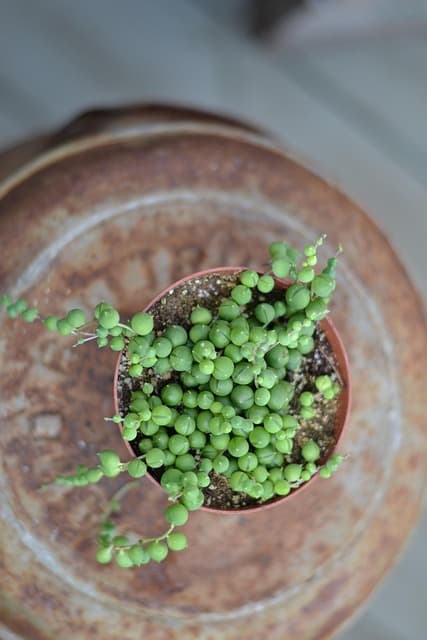
📊 Best Time & Conditions to Grow String of Pearls (Indian Climate)
| Factor | Ideal Condition |
|---|---|
| Temperature | 15–28°C |
| Sunlight | Bright indirect light |
| Soil | Gritty, fast-draining succulent mix |
| Watering | Only when pearls slightly wrinkle |
| Humidity | Low to moderate |
| Pot | Terracotta with drainage |
| Placement | Window sill or airy balcony |
🌞 Why Summer Is the Most Dangerous Season
Indian summers create a dangerous illusion: the hotter it gets, the more water the plant must need. Out of concern, people water more frequently, trying to “help” the plant cope with the heat.
In reality, the opposite is happening beneath the soil.
During extreme heat:
- Roots become stressed rather than energized
- Water uptake actually slows down instead of increasing
- Constantly wet soil turns into a breeding ground for fungal activity
So while the surface looks dry and the air feels scorching, the roots are sitting in conditions they cannot tolerate.
This is why summer becomes the most lethal season for String of Pearls indoors.
The most important summer rule is simple but counterintuitive:
👉 Water less, not more.
Instead of following a calendar or temperature-based schedule, observe the plant itself. Water only when the pearls begin to slightly wrinkle or lose firmness—a natural signal that stored moisture is finally being used up.
With String of Pearls, restraint in summer doesn’t harm the plant.
It saves it.
🌧️ Monsoon: The Silent Killer
If summer is dangerous, monsoon is often deadly—and far more deceptive.
During monsoon, the problem isn’t heat. It’s humidity that never leaves. Moisture lingers in the air, in the soil, and around the base of the plant, even when you haven’t watered recently.
Common monsoon problems include:
- Soil taking an unusually long time to dry
- Rapid increase in fungal activity below the surface
- Stem rot appearing suddenly at the soil line
What makes monsoon especially cruel is how quietly the damage happens. A plant may look stable for weeks, only to collapse almost overnight.
Monsoon Survival Rules
- Stop misting completely—humidity is already excessive
- Increase airflow with open windows or a fan
- Extend watering gaps far beyond normal schedules
- Remove any soft or damaged stems immediately to prevent spread
Many String of Pearls plants that survive harsh summer heat end up collapsing during monsoon—not because of neglect, but because rot had been building silently, long before the first visible signs appeared.
🔄 Propagation: Why It Often Fails
Propagation of String of Pearls is often advertised as effortless—snip, plant, water, done. In reality, many cuttings rot before they ever root, leaving growers confused and discouraged.
The reason is simple: this plant does not propagate like typical succulents.
❌ Common Propagation Mistakes
Most failures happen because of well-intentioned but harmful habits:
- Burying stems too deep, which traps moisture against delicate tissue
- Watering immediately after planting, before the cut has healed
- Using moist or organic-rich soil that holds water instead of releasing it
These conditions prevent callusing and invite rot long before roots have a chance to form.
✅ The Correct Way to Propagate String of Pearls
- Take a healthy trailing stem around 10–12 cm long
- Let the cutting dry and callus for 24 hours
- Place it on top of completely dry soil, not buried
- Gently press the nodes so they make light contact with the surface
- Do not water for 5–7 days
- After roots begin forming, use very light misting only
The goal is to encourage rooting without ever allowing moisture to sit against the stem.
Best time for propagation: late winter to early spring, when growth is slow but stable and humidity is lower.
With String of Pearls, patience during propagation is more important than action.
Doing less—especially at the beginning—is what allows new life to form.
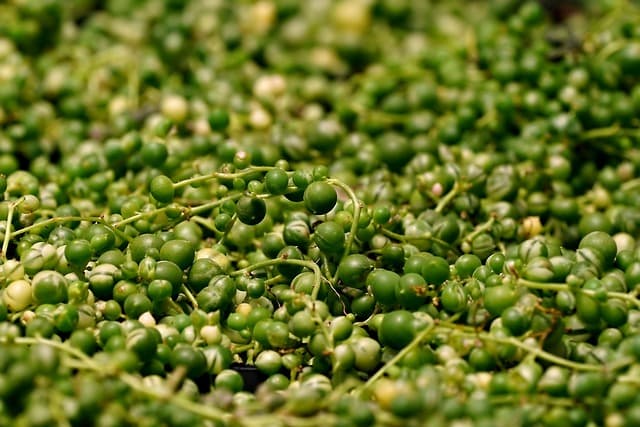
🌱 Popular Varieties of String of Pearls
While the classic green String of Pearls is the most commonly sold form, a few closely related varieties exist. They may look slightly different, but their basic needs—and vulnerabilities—remain very similar.
🌿 String of Pearls (Classic Green)
This is the form most people recognize.
- Bright green, perfectly spherical pearls
- Fastest grower among the group
- Most widely available in nurseries and online
It is also the most forgiving within an unforgiving plant category—which is why it’s usually recommended first.
🌿 Variegated String of Pearls
A visually striking but more sensitive version.
- Creamy white or pale yellow streaks on the pearls
- Slower growth due to reduced chlorophyll
- More sensitive to light stress and watering mistakes
Because variegation weakens photosynthesis slightly, this form reacts faster to overwatering, low light, or humidity stress.
🌿 String of Tears (Curio citriformis)
Often mistaken for a variation of String of Pearls.
- Teardrop-shaped leaves instead of round beads
- Slightly more tolerant of light variation
- Still vulnerable to moisture-related issues
Though its shape differs, its root behavior and watering sensitivity remain very similar.
🌿 String of Beads (Compact Form)
A form that confuses many plant owners.
- Smaller pearls with tighter, denser growth
- Often mistaken for a young or immature plant
- Not a sign of poor health when grown correctly
This compact look is genetic, not a care issue.
👉 Important note:
Care requirements across all these varieties are largely the same. However, variegated and compact forms are less tolerant of stress, meaning mistakes show faster and recovery is slower.
Different looks—same rules.
String of Pearls doesn’t change its nature just because its pearls do.
⚠️ Toxicity: Important Safety Note
String of Pearls is toxic to pets and mildly toxic to humans if ingested.
- Dangerous for cats, dogs, and rabbits
- Can cause vomiting or irritation
Always keep it out of reach of children and animals.
🛠️ Problem–Solution Chart: Understanding Plant Signals
| Problem | Likely Cause | Practical Solution |
|---|---|---|
| Pearls shrinking | Low light or dehydration | Increase light exposure |
| Mushy stems | Overwatering | Repot in dry, gritty soil |
| Pearls dropping | Root rot | Take healthy cuttings immediately |
| Yellow pearls | Excess moisture | Improve drainage and airflow |
| No growth | Dormant season | Wait for active growth period |
🌿 How to Actually Succeed With String of Pearls Indoors
To grow String of Pearls successfully indoors, the biggest shift isn’t in tools or products—it’s in how you think about care.
This plant doesn’t respond to routines.
It responds to conditions.
- Think air, not water
- Think light, not shade
- Think dry cycles, not fixed schedules
String of Pearls thrives when its environment is allowed to breathe, when light is generous but gentle, and when water is offered only after the plant has truly used what it already holds.
This is a plant shaped by restraint.
It doesn’t reward constant attention, frequent checking, or anxious care.
It rewards understanding.
And once that understanding clicks, String of Pearls stops feeling difficult—and starts behaving exactly the way it always was meant to.
🌙 A Message Written in Beads
String of Pearls doesn’t fail because it is fragile.
It fails because we treat it like an ordinary houseplant—
when in truth, it is closer to a quiet memory of the desert.
This plant was shaped by air, space, and long pauses between rain. When we hover, adjust, water, and worry too much, we erase the very conditions it depends on to survive.
“Some plants don’t ask for more care—only for less interference.”
And once you learn to step back, String of Pearls does something rare indoors:
it teaches patience by thriving in silence.

