
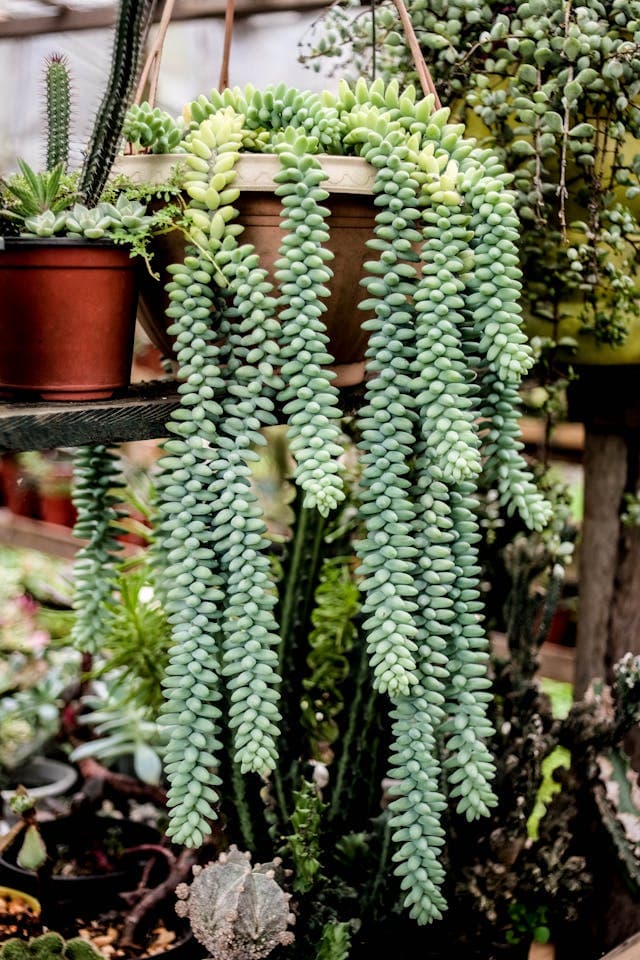
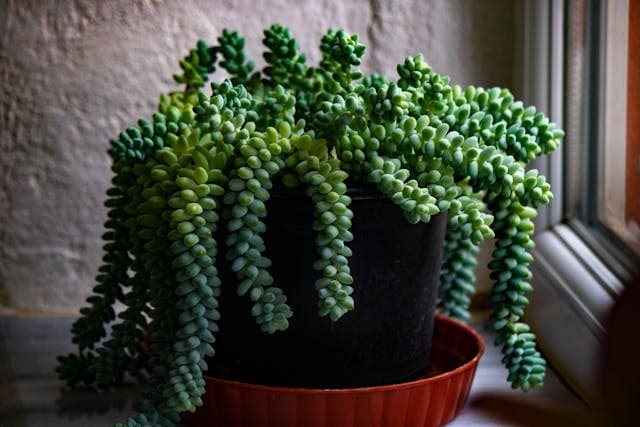
Few succulents create the kind of quiet magic that Burro’s Tail—also known as Donkey’s Tail—does. There’s something deeply calming about its long, trailing stems, each one packed with soft, teardrop-shaped leaves that spill over the pot like a slow green waterfall. It doesn’t shout for attention. It simply exists—elegant, patient, almost unreal.
Because of this dramatic beauty, many gardeners make an easy assumption: surely a plant that looks this lush must also be tough. After all, it’s a succulent. It must love harsh sun. It must tolerate neglect. It must survive anywhere.
That assumption is where most Burro’s Tail stories quietly go wrong.
Behind its sculptural appearance is a plant that is surprisingly sensitive—one that reacts strongly to light, heat, moisture, and even how often it is moved. Burro’s Tail is not a rugged desert warrior. It is a climate-aware, stress-responsive succulent that rewards gentle understanding and punishes casual mistakes. In the Indian climate especially, where summers are intense and humidity swings wildly, the margin for error becomes very small.
A little too much sun can scorch its leaves beyond recovery.
A few extra waterings can rot stems from the inside out.
One careless relocation can cause leaves to fall like beads from a broken necklace.
What makes this plant frustrating for beginners—and fascinating for patient growers—is that it rarely fails loudly. It doesn’t wilt dramatically. It doesn’t give obvious warnings. Instead, it sheds leaves, softens at the base, or simply stops growing, leaving you confused about what went wrong.
This is why the most important question for Burro’s Tail is not about fertilizer, pot size, or even watering schedules. It’s about placement.
Should Burro’s Tail live indoors or outdoors?
The answer isn’t universal, and it certainly isn’t found in one-line care tips. It depends on how this plant responds to Indian summers, filtered light versus direct sun, airflow, seasonal shifts, and even how quickly moisture evaporates in your space.
In this guide, we’ll move past myths and surface-level advice. We’ll talk honestly about what Burro’s Tail actually experiences in real homes and real balconies. We’ll explore how it behaves in different seasons, how it recovers (or doesn’t) after damage, how propagation really works, and why “less care” often means better care for this plant.
By the end, you won’t just know where Burro’s Tail grows best—you’ll understand why. And once you understand that, this plant stops feeling fragile and starts feeling deeply predictable.
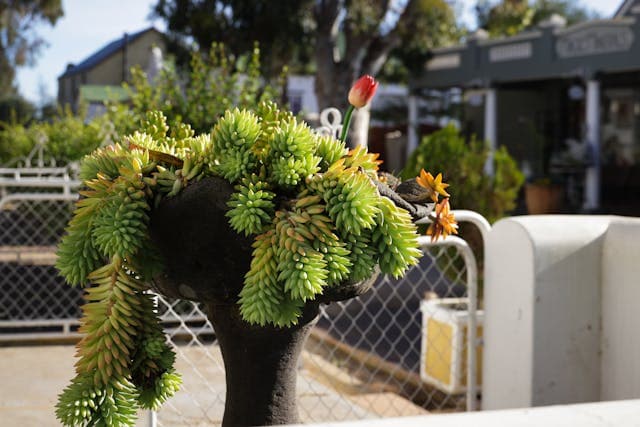
🌵 Getting to Know Burro’s Tail / Donkey’s Tail
Before deciding where this plant should live, it helps to pause and truly understand what kind of plant Burro’s Tail actually is—not what we assume it to be by its looks.
🌱 Botanical Identity (Beyond the Label)
- Common names: Burro’s Tail, Donkey’s Tail
- Scientific name: Sedum morganianum
- Plant type: Trailing succulent
- Growth habit: Long, cascading stems that spill downward, never upright
- Leaf nature: Fleshy, water-storing—and remarkably fragile
Each leaf on Burro’s Tail is a tiny reservoir. It stores water carefully, releasing it slowly during dry periods. This adaptation allows the plant to survive drought—but it comes with a trade-off. Once the leaves are full, the plant becomes extremely sensitive to excess moisture, heat buildup, and even minor physical disturbance.
This is why overwatering doesn’t just stress Burro’s Tail—it quietly destroys it. Roots suffocate, stems soften, and leaf drop begins long before rot becomes visible.
What surprises most growers is how easily the plant sheds its leaves. A light brush of the hand, a sudden movement of the pot, or frequent repositioning can cause leaves to fall like beads slipping from a thread. This isn’t a sign of weakness—it’s a survival mechanism. In nature, dropped leaves root where they land, helping the plant spread.
And that leads to the most misunderstood truth about Burro’s Tail:
It isn’t fragile because it is weak.
It is fragile because it evolved for stable, predictable environments—places without sudden heat spikes, heavy rains, or constant handling.
When we grow it in homes or balconies, especially in the Indian climate, we unknowingly expose it to exactly the conditions it never evolved to handle. Understanding this single fact changes how you place it, water it, and even walk past it.
Once you see Burro’s Tail this way, care stops feeling confusing—and starts feeling logical.
🌍 Natural Habitat: What Nature Quietly Teaches Us
To understand where Burro’s Tail truly feels at home, we need to look at where it evolved—long before it became a hanging basket favourite.
In the wild, Sedum morganianum is native to Mexico, particularly the southern regions. These landscapes are not lush jungles or open deserts. They are balanced environments—dry, airy, and predictable.
Here, Burro’s Tail grows in conditions that are surprisingly gentle:
- Bright but filtered sunlight, often broken by rocks or terrain
- Rocky, fast-draining slopes where water never lingers
- Warm, stable temperatures, not sudden heat extremes
- Low to moderate rainfall, with long dry intervals in between
Just as important as what it does experience is what it never does.
In nature, Burro’s Tail does not grow:
- Under relentless, scorching desert sun
- In soil that stays wet or compacted
- In environments with constant, trapped humidity
This natural setting tells us something crucial: Burro’s Tail evolved in places where stress was low but consistent, not intense or chaotic. It learned how to store water, not how to endure excess. It adapted to stability—not to sudden monsoons, concrete heat reflection, or humid nights followed by harsh sun.
When we place this plant outdoors in India—especially without protection—we unknowingly recreate conditions it has never evolved to handle: blazing summer sun, sudden heavy rain, lingering humidity, and heat radiating from walls and floors.
So even before we talk about pots, watering, or seasons, nature gives us a quiet warning.
Uncontrolled outdoor exposure may look natural—but for Burro’s Tail, it often isn’t..
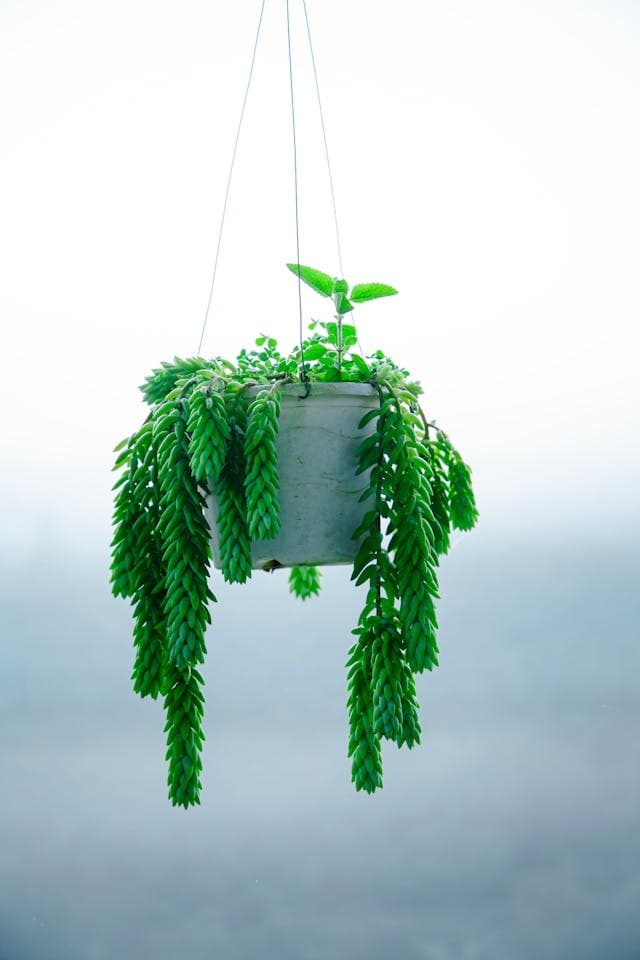
☀️ Light: The Thin Line Between Thriving and Suffering
If there is one factor that decides whether Burro’s Tail flourishes quietly or declines without explanation, it is light. Not water. Not soil. Not fertilizer. Light determines everything else.
This plant does not want darkness—but it also does not forgive excess. It lives in a narrow comfort zone, and crossing that line—especially outdoors—often leads to irreversible damage.
🪟 Indoor Light Conditions: Where Burro’s Tail Feels Safest
Indoors, Burro’s Tail performs best when light is bright but softened, never harsh or direct. Think of light that fills a room, not light that burns the skin.
Ideal indoor setups include:
- Bright indirect sunlight for most of the day
- East-facing windows, where gentle morning sun arrives without heat stress
- South-facing windows filtered through curtains, sheer blinds, or distance from the glass
When indoor light is correct, the plant shows its comfort clearly:
- Stems grow compact and dense, not stretched
- Leaves sit tightly stacked, forming that signature beaded look
- Roots remain strong and stable
- Growth stays balanced, slow, and stress-free
But indoor light that is too weak creates its own problems. The plant doesn’t die quickly—it adapts poorly.
Low-light stress often appears as:
- Elongated, stretching stems (etiolation)
- Visible gaps between leaves
- A pale, tired look instead of a fresh green tone
This is the plant quietly asking for more light—not more water.
🌤️ Outdoor Light Conditions: Where Risk Begins
Outdoors, light becomes far more unpredictable—especially in India. While Burro’s Tail can survive outside, it does so only under very controlled conditions.
Outdoor light must be:
- Bright, but always paired with partial shade
- Sheltered from afternoon and western sun
- Completely protected during peak summer months
Even a few hours of direct summer sun can overwhelm this plant.
Common outdoor sun damage includes:
- Leaves turning pale, yellow, or brown from sunburn
- Sudden, heavy leaf drop within days
- Stem tissue weakening or collapsing—damage that does not heal
The most deceptive part? Sun damage often appears after exposure, making it difficult to connect cause and effect.
This is why many Burro’s Tail plants seem fine outdoors—until they suddenly aren’t.
Light that feels pleasant to us can be brutal to a plant evolved for filtered exposure. Indoors, light is easier to control. Outdoors, one hot afternoon is often enough to cross the line from thriving into suffering.
🌡️ Temperature Reality: Indoor vs Outdoor in India
Light may start the conversation, but temperature decides the outcome. For Burro’s Tail, the difference between comfort and collapse is often just a few degrees—and in India, those degrees matter a lot.
🌿 Ideal Temperature Window (Where Growth Feels Natural)
Burro’s Tail grows best when temperatures remain calm and predictable:
- Best growth: 15°C – 28°C
- Stress begins: Above 32°C
- Danger zone: 35–40°C and beyond
Within this safe range, the plant manages its stored water efficiently. Leaves stay firm, roots function properly, and growth remains slow but steady. Outside this range, the plant doesn’t adapt—it defends, and defense always costs energy.
🏠 Indoor Advantage: Stability Over Strength
Indoors, temperature rarely behaves violently. This is where Burro’s Tail gains its biggest advantage.
Indoor conditions offer:
- Stable temperatures throughout the day and night
- Protection from extreme heatwaves that touch 45–47°C in many regions
- Buffering from hot winds, sudden spikes, and cold winter drafts
- A controlled environment where stress accumulates slowly, not suddenly
Even without air conditioning, indoor spaces heat up more gradually than balconies, terraces, or open gardens. That gradual change is something Burro’s Tail can tolerate.
🌞 Outdoor Reality: Where Stress Builds Silently
Outdoors in India, temperature is rarely gentle.
Common outdoor challenges include:
- Intense summer heat radiating from walls, floors, and railings
- Hot, drying winds that dehydrate leaves faster than roots can respond
- Sudden temperature jumps between morning and afternoon
- Monsoon humidity that traps heat and prevents proper drying
The most dangerous part is that damage often happens before symptoms appear. By the time leaves begin to soften or fall, internal stress has already crossed the recovery threshold.
This is why Burro’s Tail plants kept outdoors often seem “fine” for weeks—then decline rapidly without warning.
⚠️ The Honest Verdict on Outdoor Growing
In most parts of India, year-round outdoor growing is unsafe for Burro’s Tail. Not because the plant is weak—but because the environment is unpredictable and extreme in ways it never evolved to handle.
Outdoor placement may work temporarily, or seasonally, or in very specific microclimates. But as a long-term strategy, it carries far more risk than reward.
For this plant, consistency matters more than intensity. And consistency is something indoor spaces provide far better than open air.
🌱 Best Growing Months for Burro’s Tail in India
Burro’s Tail doesn’t grow by the calendar—it grows by comfort. In India, that comfort arrives only during a short window each year, when light is gentle and temperatures stop swinging wildly.
For most regions, the plant performs at its best between October and February. During these months, daytime temperatures usually remain within the safe 15°C–28°C range, and nights cool down without becoming harsh. This balance allows the plant to breathe, store water properly, and grow without stress.
You’ll often notice clear signs of well-being during this period:
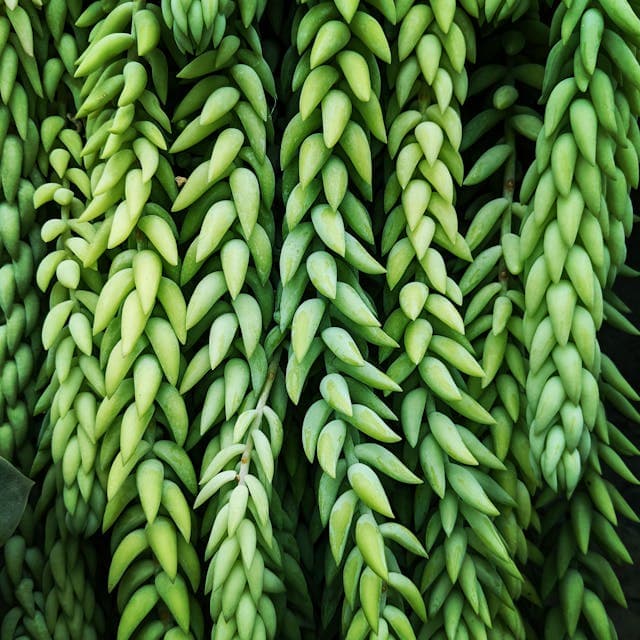
- Leaves appear plumper and more tightly packed
- Trailing stems feel firmer and stronger, not limp
- Growth looks slow but confident, not stretched or forced
- Mature plants may even surprise you with flowers, a rare reward
March and early April can still support healthy growth—but only with caution. As heat begins to rise, Burro’s Tail needs extra protection from direct sun and hot surfaces. This is the transition phase, where careful placement matters more than ever.
Once temperatures consistently cross 35°C, the plant doesn’t “grow poorly”—it shifts into survival mode. Growth slows dramatically, leaves become more vulnerable, and any mistake (extra watering, harsh light, humidity) carries a much higher risk. This is not dormancy in the traditional sense—it’s a stress response.
Understanding this seasonal rhythm changes everything. It tells you when to expect growth, when to simply maintain, and when to stop pushing the plant altogether. Burro’s Tail thrives when we respect its timing—and suffers when we ignore it.
Grow with the season, and the plant quietly rewards you.
💧 Watering: Why Placement Changes Everything
Burro’s Tail hates excess water far more than temporary dryness. This is the single truth that decides whether the plant survives—or slowly collapses without obvious warning.
But here’s what many growers miss: watering problems are rarely about how much water you give. They’re about where the plant is placed.
🏠 Indoor Watering: Control Creates Safety
Indoors, watering becomes predictable—and predictability is exactly what Sedum morganianum needs.
Indoor conditions allow:
- Soil to dry evenly from top to bottom
- Zero interference from unexpected rain
- Better airflow control
- Easy monitoring of pot weight and soil dryness
Because the environment is stable, the roots get time to breathe between waterings.
A realistic indoor watering rhythm in India looks like this:
- Summer: Once every 12–15 days
- Winter: Once every 20–25 days
These are not rigid rules—but safe averages. The key is always dry soil, not the calendar. Indoors, waiting a little longer is almost always safer than watering early.
🌧️ Outdoor Watering: Where Things Go Wrong
Outdoors, watering stops being a choice.
Even if you water carefully, the environment doesn’t.
Outdoor Burro’s Tail plants face:
- Sudden, unplanned rainfall
- High humidity that slows evaporation
- Soil that stays damp longer than expected
- Heat that encourages rot instead of drying
This is why so many outdoor Burro’s Tail plants rot without ever being overwatered by hand.
The roots remain wet. Oxygen disappears. Rot begins quietly at the base. By the time leaves start falling or stems soften, damage is already advanced.
👉 Outdoor plants often rot not because of watering—but because the soil never gets a chance to dry properly.
This is especially dangerous during the Indian monsoon, when humidity stays high even on days without rain. What looks like “safe moisture” becomes trapped stress.
⚠️ The Hidden Trap
Many growers respond to outdoor leaf drop by watering less—when the real problem is placement, not frequency. Once roots are compromised, reducing water alone cannot reverse the damage.
Indoors, you control water.
Outdoors, water controls the plant.
And Burro’s Tail was never built for that kind of uncertainty.
🪴 Pot, Soil & Drainage: Why Indoors Wins Again
For Burro’s Tail, the pot and soil are not just containers—they are life support systems. Even the perfect soil mix can fail if drying is delayed, and this is where indoor placement quietly outperforms outdoor setups.
🧱 Best Pot Choice: Let the Roots Breathe
Burro’s Tail prefers pots that release moisture instead of trapping it.
The most reliable options are:
- Terracotta or clay pots, which absorb excess moisture and dry faster
- Hanging containers, allowing air to circulate freely around the pot
- Large, unobstructed drainage holes, not decorative pinholes
Plastic pots may look neat, but they hold moisture too long—especially dangerous in warm or humid conditions. For this plant, faster drying always beats water retention.
🌱 Ideal Soil Mix: Built for Speed, Not Storage
Burro’s Tail doesn’t want rich soil. It wants quick escape routes for water.
A balanced, root-safe mix looks like this:
- 50% cactus or succulent mix
- 25% coarse sand (not fine builder’s sand)
- 25% perlite or pumice
This combination creates air pockets, prevents compaction, and allows water to pass through without hesitation. Indoors, this mix behaves exactly as intended.
🏠 Why Indoor Placement Makes the Difference
Indoors, this pot-and-soil system actually works the way it was designed to.
Indoor placement ensures:
- Predictable drying cycles
- Far less chance of fungal or bacterial growth
- Roots that dry evenly instead of staying damp at the bottom
- Fewer surprises after watering
Because moisture leaves the pot gradually—but completely—the roots remain oxygenated and healthy.
🌧️ What Goes Wrong Outdoors
Outdoors, even the best setup starts fighting the environment.
Outdoor placement often invites:
- Waterlogging from rain or humidity
- Green algae forming on soil and pot surfaces
- Slower evaporation due to moisture-laden air
- Root suffocation despite “good” drainage
The danger isn’t obvious at first. The soil may look dry on top while staying wet underneath. By the time symptoms appear above the soil line, the roots are already struggling.
This is why Burro’s Tail failures are often blamed on “bad soil” or “wrong pots,” when the real issue is exposure.
Indoors, soil behaves honestly.
Outdoors, soil lies.
And Burro’s Tail pays the price.
🗓️ Season-Wise Care Guide for Burro’s Tail (Indian Climate)
| Season | Temperature Range | Light Requirement | Watering Frequency | Key Care Tips |
|---|---|---|---|---|
| Winter (Oct–Feb) | 12°C – 28°C | Bright indirect light | Every 15–20 days | Best growing season; allow full soil drying |
| Spring (Mar–Apr) | 20°C – 32°C | Bright light with shade | Every 12–15 days | Protect from sudden heat |
| Summer (May–Jun) | 35°C – 47°C | Indirect light only | Every 20–30 days | Survival mode; move indoors |
| Monsoon (Jul–Sep) | 25°C – 35°C + humidity | Bright light, airflow | Only if soil fully dry | Keep away from rain |
💧 Why Watering Must Be Reduced in Summer for Burro’s Tail
During the Indian summer, Burro’s Tail isn’t growing—it’s enduring.
Once temperatures begin crossing 35–40°C, Sedum morganianum naturally shifts out of active growth and into survival mode. This is a critical detail many growers overlook. In survival mode, the plant deliberately slows its internal processes, especially root activity.
The roots stop absorbing water efficiently—not because the soil is dry, but because the plant is protecting itself from heat stress. When we continue watering as usual during this phase, moisture lingers in the pot longer than expected. That trapped water heats up, deprives roots of oxygen, and quietly creates the perfect conditions for rot and fungal infections.
This is why summer damage often feels sudden. The plant looks fine for days or weeks, then drops leaves rapidly or collapses at the base. The failure didn’t happen overnight—it started underground.
What makes Burro’s Tail different from many houseplants is its built-in reserve system. Those thick, bead-like leaves are designed to store enough moisture to survive long dry stretches. In extreme heat, the plant relies on these reserves—not fresh water.
In Indian conditions, watering less in summer is not neglect—it is protection.
Reducing watering:
- Prevents overheated, suffocating roots
- Stops rot before it starts
- Reduces fungal pressure in warm, humid air
- Allows the plant to “pause” safely until temperatures drop
Once the heat eases and nights cool down, Burro’s Tail naturally resumes growth. At that point, watering can slowly return to normal.
The key lesson is simple but powerful:
Never water Burro’s Tail based on habit during summer—water based on what the plant is capable of handling.
Sometimes the best care is knowing when to step back.
🌱 Propagation: Easy—But Only When Timing Is Right
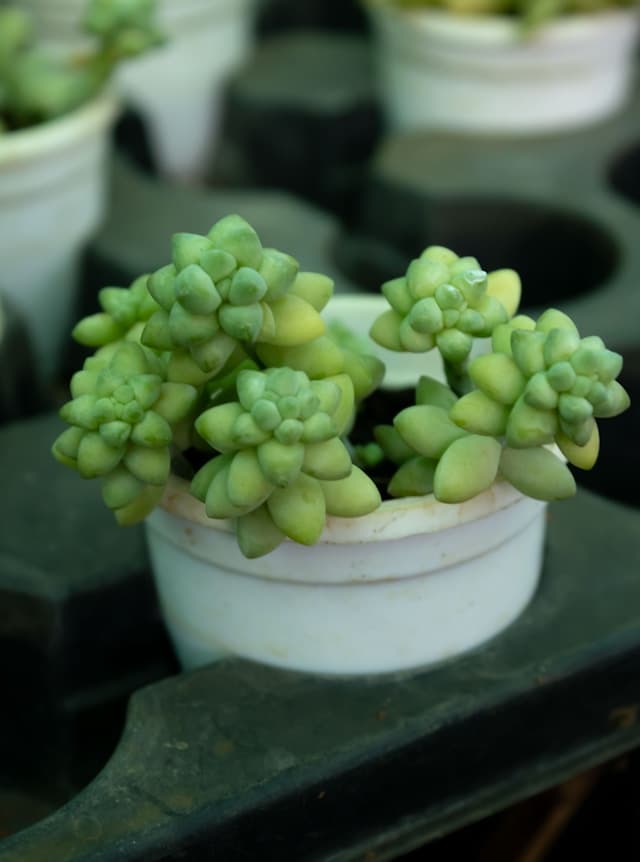
Burro’s Tail has a reputation for being easy to propagate, and that reputation is deserved—but only under the right conditions. This is not a plant that forgives rushed attempts or poor timing.
Propagation success depends far less on technique and far more on season, temperature, and moisture control.
🍃 Leaf Propagation: Slow, Quiet, and Delicate
Leaf propagation works beautifully with Sedum morganianum—but only when leaves are handled gently and allowed to rest before rooting.
A reliable approach:
- Gently twist a healthy leaf from the stem (never pull)
- Let the leaf dry for 2–3 days until the base fully callouses
- Place it on dry, well-draining soil without burying
- Wait patiently—mist lightly only after roots appear, not before
The most common mistake here is moisture too early. Fresh leaves rot easily if misted before they are ready. When left alone, they do the work themselves.
✂️ Stem Cuttings: Faster, But Still Demanding Patience
Stem cuttings root faster than leaves, but they still need restraint.
Best practice:
- Cut a 5–8 cm healthy stem using a clean blade
- Allow the cut end to callous fully (this is non-negotiable)
- Insert into dry soil, not damp
- Water only after 7 days, once roots begin forming
Early watering is the fastest way to lose a cutting—especially in warm weather.
🏠 Why Indoor Propagation Works Better
Indoor propagation has a much higher success rate for one simple reason: control.
Indoors, you get:
- Stable temperatures
- No rain interference
- Predictable drying
- Lower fungal pressure
Outdoors, heat spikes, humidity, or unexpected moisture often rot cuttings before roots even form. Indoors, the plant gets the calm, steady environment it needs to focus on root growth instead of survival.
⏳ The Real Secret: Timing Over Speed
The best propagation window in India is October to February, when temperatures are mild and the plant is naturally active. Summer attempts often fail—not because propagation is hard, but because the plant is conserving energy, not creating roots.
With Burro’s Tail, propagation is not about doing more.
It’s about doing less—at the right moment.
☀️ How to Save Burro’s Tail in Hot Indian Summers
Indian summers are not just uncomfortable for Burro’s Tail—they are the most dangerous phase of its entire year. When temperatures climb toward 45–47°C, Sedum morganianum is no longer trying to grow. It is simply trying to stay alive.
At this stage, survival depends less on care and more on damage control.
The first and most important step is relocation. Move the plant indoors, or at the very least into a shaded, well-ventilated area where heat does not build up. Never leave it exposed to direct sun, even for a short time. What feels like “soft sunlight” to us can be lethal to this plant in peak summer.
Light during this period should be bright but indirect only—enough to maintain health, not stimulate growth. Growth is not the goal right now.
Watering must be drastically reduced. In extreme heat, the roots slow down and cannot process moisture efficiently. Water only when the soil is completely dry from top to bottom—and then wait a little longer. Overwatering in summer doesn’t refresh the plant; it overheats and suffocates the roots.
Avoid misting entirely. Added humidity during summer creates the perfect environment for fungal problems, especially when airflow is limited.
Pot choice matters more than ever. Terracotta pots help release excess heat and moisture, while elevating the pot slightly prevents heat transfer from hot floors, tiles, or concrete surfaces.
And perhaps the hardest rule for gardeners to follow:
Do nothing extra.
Do not repot.
Do not fertilize.
Do not attempt propagation.
Any disturbance during peak summer adds stress the plant cannot recover from.
Summer care for Burro’s Tail is not about improvement—it is about preservation. If the plant comes through the heat intact, even without visible growth, you have succeeded. Once temperatures drop, recovery and growth will follow naturally.
Sometimes the best way to care for a plant is to protect it—and then leave it alone.
🔄 Summer Damage Recovery: Helping Burro’s Tail Heal, Not Hurry
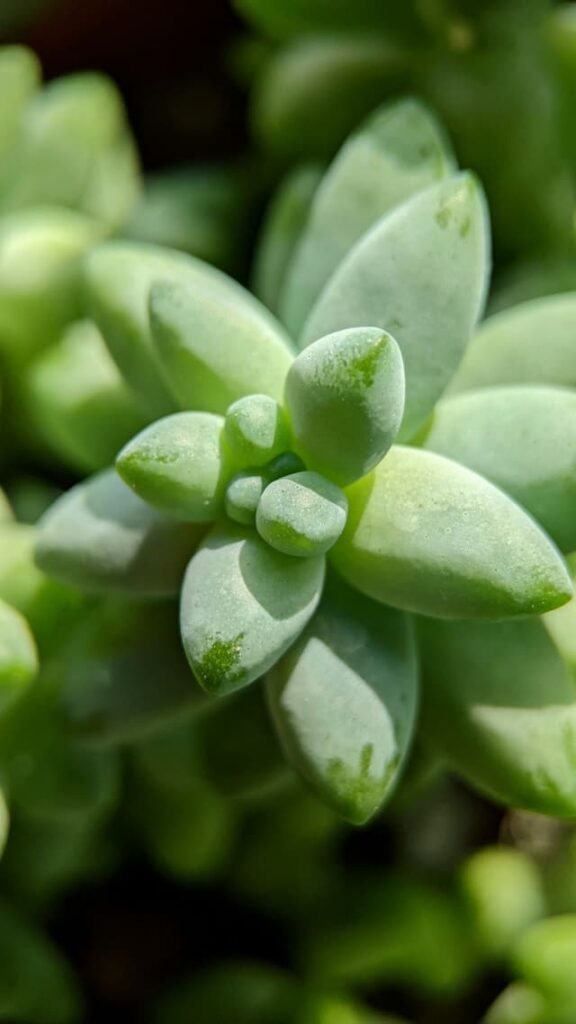
Seeing leaf drop, shriveling, or soft stems after summer can feel alarming—but for Burro’s Tail, this is often a stress response, not a death sentence. Recovery is very possible, as long as the plant is given time and the right conditions.
The first step is relocation. Move the plant immediately into a bright indoor space with indirect light. Avoid balconies, windowsills with heat buildup, or areas with poor airflow. Right now, stability matters more than brightness.
Next, inspect the plant honestly. Using clean, sterile scissors, trim away any stems that appear blackened, mushy, or collapsed. This prevents rot from spreading and helps the plant redirect energy to healthy tissue. Do not over-prune—remove only what is clearly damaged.
Resist the urge to water right away. Even after stress, Sedum morganianum needs dry conditions to reset. Wait until the soil is completely dry from top to bottom—and then wait a little longer. Moist soil during recovery often delays healing rather than speeding it up.
Once temperatures consistently fall below 32°C, you can slowly resume gentle watering. Not frequent watering—just careful, spaced hydration that supports roots without overwhelming them.
Fertilizer has no role in recovery. Feeding a stressed plant is like forcing food on someone with a fever. Avoid fertilizers entirely until winter, when growth naturally resumes.
Any healthy leaves that fell during summer can be saved. Place them aside in a dry, shaded area for later propagation, once conditions improve. Never attempt recovery propagation during peak heat—the plant needs to stabilize first, not multiply.
Recovery with Burro’s Tail is rarely fast, but it is often successful. As the environment calms, the plant quietly rebuilds—leaf by leaf, stem by stem—without needing intervention.
The most important ingredient isn’t treatment.
It’s patience.
🧪Burro’s Tail (Sedum morganianum) is purely ornamental. It is grown for beauty alone—not for consumption.
- ❌ Not edible
- ⚠️ Mildly toxic if ingested
- 🚫 Should be kept away from pets and small children
If eaten, the plant may cause mild digestive discomfort such as nausea or irritation, especially in pets like cats, dogs, and rabbits. While it is not considered highly poisonous, it is not safe to experiment with and should never be treated as an edible succulent.
Because its trailing stems often hang low and its leaves resemble soft beads, Burro’s Tail can easily attract curious pets or children. Placement matters—keep it elevated, out of reach, and clearly separated from edible plants.
This is a plant to admire, not taste. Its role is visual calm, not nourishment.
🌸 Flowering: Indoor or Outdoor—What Really Happens?
Flowering in Burro’s Tail is not a routine event—it’s a quiet reward, offered only when the plant feels completely at ease. Many healthy plants never flower at all, and that doesn’t mean something is missing.
For Sedum morganianum to bloom, several conditions must align at the same time.
Burro’s Tail produces its small, pinkish-red flowers only when it is:
- Fully mature (young plants simply won’t bloom)
- Receiving ideal light consistently, not occasionally
- Free from stress caused by heat, excess water, repotting, or frequent movement
🌿 Outdoor Flowering: Possible, but Rare in India
Outdoors, flowering is possible only in very mild climates—where temperatures stay moderate, sunlight is bright but filtered, and stress remains low. Even then, the plant must be protected from harsh sun, heavy rain, and humidity.
In most parts of India, outdoor conditions are too unpredictable. Heatwaves, monsoon moisture, and sudden temperature swings usually interrupt the stability required for flowering. This is why outdoor blooms are uncommon and often short-lived.
🪟 Indoor Flowering: Rare, But More Predictable
Indoors, flowering is still rare—but more achievable. A mature plant placed near a bright window with steady indirect light, stable temperatures, and minimal disturbance has the best chance.
When conditions are right, flowers typically appear at the tips of trailing stems. They are delicate, understated, and easy to miss—but deeply satisfying to notice.
🌱 The Right Perspective on Flowers
Burro’s Tail is not a flowering showpiece. It is a foliage plant first and foremost. If flowers appear, they are a bonus—not a goal to chase.
Chasing blooms often leads to:
- Overwatering
- Excess light
- Unnecessary fertilizing
All of which reduce the plant’s long-term health.
With Burro’s Tail, comfort comes before flowers. When the plant feels safe, stable, and unpressured, it may bloom on its own—quietly, briefly, and beautifully.
And if it never does, it is still doing exactly what it was meant to do.
🏡 Final Verdict: Indoor or Outdoor?
After understanding its light needs, temperature limits, watering behavior, seasonal rhythm, and recovery patterns, the answer becomes clear.
✅ Best Overall Choice: INDOOR
For Sedum morganianum, indoor growing is not just safer—it is closer to the stable conditions this plant evolved for.
Indoor placement wins because it offers:
- Stable temperatures without sudden spikes
- Protection from extreme heat, monsoon rain, and humidity
- Far lower risk of root rot and fungal issues
- Better leaf retention with minimal stress
- Easier, more predictable long-term care
Indoors, Burro’s Tail doesn’t need constant correction. It settles, adapts, and grows at its own quiet pace.
🌤️ Outdoor Use: Limited, Seasonal, and Controlled
Outdoor growing is not impossible—but it is conditional, not permanent.
Outdoor placement works only:
- In bright, shaded balconies with good airflow
- During winter and early spring when temperatures are mild
- With full protection from rain, harsh sun, and heat buildup
Even then, outdoor exposure should be temporary. The moment heat intensifies or humidity rises, the plant must be moved back indoors.
🌱 The Honest Takeaway
Burro’s Tail is not a “tough outdoor succulent” pretending to be delicate.
It is a delicate plant pretending to be tough.
When grown indoors, it rewards patience with beauty, balance, and longevity. Outdoors, it survives only when conditions happen to align—and those moments are brief in the Indian climate.
If your goal is not just survival, but a plant that stays full, calm, and beautiful year after year, indoor growing isn’t a compromise.
It’s the correct choice.
🌿 Not a Conclusion—A Gentle Reminder
Burro’s Tail doesn’t ask to be mastered or corrected. It asks to be understood. When we slow down, observe its rhythm, and stop forcing growth where only survival is possible, the plant responds in its own quiet way. It trails not because it is dramatic, but because that is how it rests.
Every fallen leaf is not a failure—sometimes it is a message. A reminder to ease back, to respect heat and season, to trust patience over action. In caring for Burro’s Tail, we learn something subtle: the most lasting beauty often comes from restraint, not effort.
Care it gently, place it wisely, and then allow it the dignity of time.
That is where this plant—and the gardener—truly thrives.

